Red Light Therapy for Improved Sleep Quality: A 2026 Guide

Table of Contents
- How Red Light Therapy for Improved Sleep Quality Works
- Red Light Therapy for Melatonin Production
- The Best Time of Day for Red Light Therapy
- How Long to Use Red Light Therapy for Sleep
- Red Light vs. Blue Light: What Matters for Sleep
- Contraindications and Safety for Sleep Disorders
- Integrating Red Light Therapy Into Your Sleep Hygiene Routine
- Frequently Asked Questions
Last Updated: September 28, 2026
How Red Light Therapy for Improved Sleep Quality Works
Red light therapy for improved sleep quality is a non-invasive technique that uses specific wavelengths of red and near-infrared light to influence the biological processes governing your sleep-wake cycle. At TheCoolVibeShop, we explain it simply: you absorb light energy through your skin, and that energy supports the cellular functions that regulate rest.

The mechanism rests on photobiomodulation, which is the process by which light photons interact with mitochondria to support cellular energy production. Your biological clock depends on these energy signals to time melatonin release correctly.
Most guides treat light therapy as a single intervention. It isn't. The effect depends on wavelength, timing, and duration working together.
The role of photobiomodulation in sleep regulation
Photobiomodulation targets the mitochondria inside your cells. When red and near-infrared light reach sufficient depth, they support mitochondrial function, which in turn influences how your body manages energy and recovery across the day.
That matters for sleep because your circadian rhythm is an energy-timing system. When cellular energy production is well supported during the day, the natural drop that signals sleep onset arrives more predictably. A common mistake is assuming more light equals better results. In practice, consistent moderate sessions beat long, irregular ones.
Red Light Therapy for Melatonin Production
Red light therapy for melatonin production works indirectly. The therapy does not deliver melatonin; it supports the conditions under which your pineal gland releases it on schedule. Understanding why requires knowing which cells actually read the light.

The cells that set your clock
Your circadian timing is anchored by the suprachiasmatic nucleus (SCN), a cluster of roughly 20,000 neurons in the hypothalamus. The SCN does not receive light directly. It receives signals from intrinsically photosensitive retinal ganglion cells (ipRGCs), a small set of cells in the retina that contain the photopigment melanopsin.
Melanopsin is the key detail most guides skip. Its peak sensitivity sits around 480 nm, in the blue portion of the spectrum. That is why bright blue light in the evening, phones, tablets, overhead LEDs, suppresses melatonin and pushes sleep onset later. Red and near-infrared wavelengths fall well outside melanopsin's peak sensitivity, so they do not trigger that same suppression signal.
Why red and near-infrared still matter
If red light does not hit melanopsin, how does it help? Two mechanisms are commonly cited in the research literature:
- Mitochondrial support in tissues exposed to the light. Photobiomodulation at 660 nm and 850 nm supports cellular energy production, which practitioners link to better daytime energy regulation and a more predictable evening drop.
- Absence of the blue-light suppression signal. By replacing a blue-heavy evening light source with a red-dominant one, you remove the signal that tells the SCN to delay melatonin release.
According to the National Center for Complementary and Integrative Health on light therapy, light-based approaches are studied for their influence on circadian timing rather than as direct hormone replacements. That framing matters: you are not adding melatonin, you are protecting the window in which your body releases it.
660 nm vs 850 nm: which wavelength for sleep?
This is the distinction most articles on this topic never make. The two wavelengths behave differently:
| Wavelength | Type | Typical Depth | Best Fit for Sleep Use |
|---|---|---|---|
| 660 nm | Red (visible) | ~1-2 cm into skin | Evening wind-down, surface-level relaxation, skin and mood support |
| 850 nm | Near-infrared (invisible) | ~3-5 cm into tissue | Deeper muscle and joint recovery, post-workout sessions earlier in the day |
A practical evening rule
Use warmer red wavelengths in the hours before bed and cut screens that emit strong blue light. That combination gives your body the darkness signal it expects. A red-dominant session does not cancel out a bright phone screen, it just stops adding to the problem.
The Best Time of Day for Red Light Therapy
The best time of day for red light therapy depends on your goal. For sleep, most people do best with a session in the late evening, roughly one to two hours before bed. This aligns light exposure with the wind-down phase of your sleep-wake cycle.
Full Body Red Light Therapy Mat →
| Goal | Best Time | Typical Session Length | Frequency |
|---|---|---|---|
| Sleep onset support | 1-2 hours before bed | 10-20 minutes | Daily |
| Post-workout recovery | After training | 10-20 minutes | As needed |
| General relaxation | Evening wind-down | 10-15 minutes | Daily |
| Morning energy | Within an hour of waking | 5-10 minutes | Most days |
How Long to Use Red Light Therapy for Sleep
How long to use red light therapy for sleep is typically 10 to 20 minutes per session. Shorter sessions done consistently outperform longer, sporadic ones.
Red Light vs. Blue Light: What Matters for Sleep
Blue light and red light push your body in opposite directions. Blue light in the evening suppresses melatonin and delays sleep onset. Red and near-infrared light do not carry that suppression effect, which is why red light fits better into an evening routine.
Contraindications and Safety for Sleep Disorders
Red light therapy is generally well tolerated, but it is not right for everyone. Certain sleep disorders need medical evaluation before you add any at-home device.
- Sleep apnea: Light therapy does not treat airway obstruction. See a clinician.
- Restless legs syndrome: Light exposure is not a substitute for diagnosis or treatment.
- Photosensitivity conditions: Check with a doctor before use.
- Medications that increase light sensitivity: Some prescriptions raise your risk of skin reactions.
Integrating Red Light Therapy Into Your Sleep Hygiene Routine
Sleep hygiene is the set of daily habits that shape how easily you fall asleep and stay asleep. Red light therapy works best as one part of that routine, not as a standalone fix. The angle most guides miss: the order and timing of those habits matters as much as the habits themselves. Below is a concrete sleep stack, a timed sequence you can run most nights.
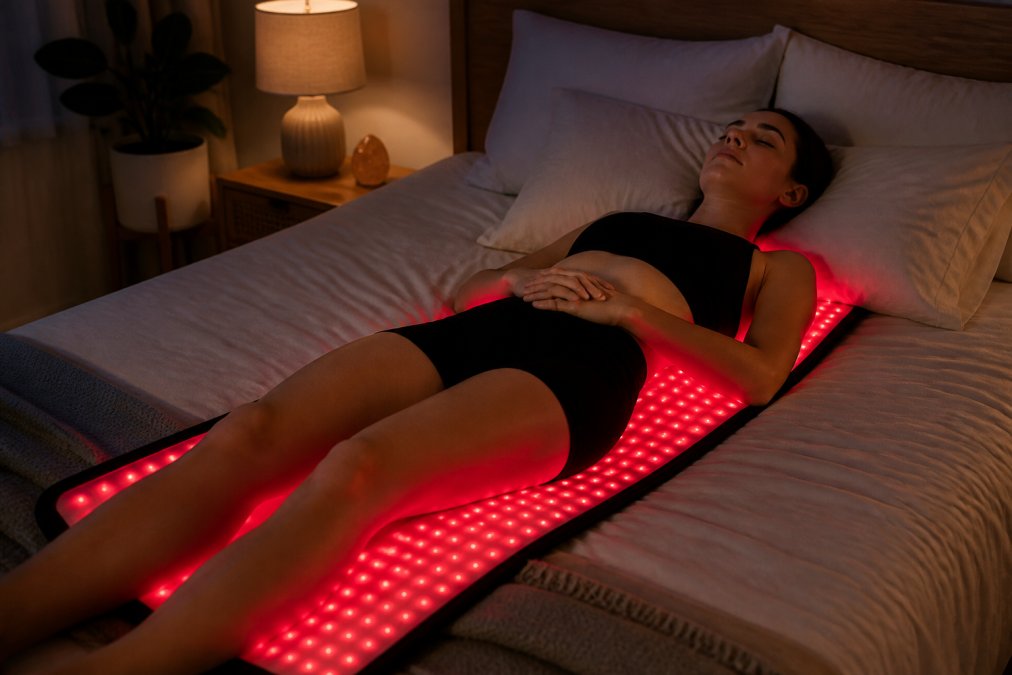
The 90-minute wind-down stack
This sequence assumes a target bedtime of, say, 10:30 p.m. Shift the whole block earlier or later to match your schedule, but keep the internal spacing intact.
What each layer actually does
| Layer | Primary Mechanism | Typical Timing |
|---|---|---|
| Red light session (660 nm) | Removes blue suppression signal; supports relaxation | 60-90 min before bed |
| Temperature drop | Triggers core-body cooling tied to sleep onset | 30-60 min before bed |
| Caffeine cutoff | Prevents adenosine receptor blockade | ~8 hours before bed (early afternoon) |
| Screen cutoff | Removes melanopsin-triggering blue light | 90 min before bed |
| Consistent wake time | Anchors the SCN's daily rhythm | Same time daily, weekends included |
Notice that the wake time is on the list. A stable morning wake time does more for circadian anchoring than any evening intervention, because it sets the phase of the entire cycle. Red light therapy amplifies a good routine. It cannot rescue a chaotic one.
Where devices fit
For targeted wind-down support, TheCoolVibeShop's Cordless Red Light Therapy for Neck & Shoulders uses 660nm red and 850nm near-infrared light in a hands-free design, so you can wear it while reading or winding down. If you prefer full-body coverage, the Full Body Red Light Therapy Mat lets you lie down and relax for a dedicated session. Both fit the evening window without adding effort to your day.
When to adjust the stack
If you are still lying awake 20+ minutes after lights out for more than two weeks, change one variable at a time, usually the red light session length or its distance from bedtime, rather than overhauling everything at once. And if you have a diagnosed sleep disorder such as sleep apnea or bipolar disorder, run any light-based routine past your clinician first, since timed light exposure can interact with mood cycling and other conditions.
Frequently Asked Questions
Is it okay to do red light therapy every night?
Yes, red light therapy is generally safe for daily use. Most devices are designed for consistent, gentle sessions. For sleep support, a 10 to 20 minute session each evening fits well into a wind-down routine. The key is keeping the therapeutic dose moderate. Overuse will not speed results and may cause restlessness in some people. Start with shorter sessions and adjust based on how you feel.
How does red light therapy influence melatonin production?
Red and near-infrared light stimulate mitochondrial function in cells, which supports cellular energy and may help regulate cortisol. Because red light does not suppress melatonin the way blue light does, evening exposure can support the body's natural melatonin release. This helps shift your sleep-wake cycle toward a more consistent schedule. The effect is indirect but meaningful when paired with good sleep hygiene.
How long does it take to see sleep improvements with red light therapy?
Most users notice subtle changes in sleep onset and sleep quality within one to two weeks of consistent use. Full benefits for circadian rhythm and sleep architecture often take three to four weeks. Consistency matters more than session length. Using your device at the same time each evening helps your biological clock adapt. If you see no change after a month, adjust your timing or duration.
Can red light therapy replace traditional sleep aids?
Red light therapy is not a replacement for prescribed sleep medications or treatment for conditions like sleep apnea. It works best as a complementary tool that supports your body's natural sleep-wake cycle. Many people use it alongside sleep hygiene practices such as consistent bedtimes, reduced evening screen time, and a cool dark bedroom. Talk to your doctor before changing any treatment plan.