Massage Guns vs Foam Rollers for Recovery

Table of Contents
- Massage Guns vs Foam Rollers: Core Differences
- Benefits of Percussive Therapy for Muscle Recovery
- Benefits of Foam Rolling for Soreness and Stiffness
- How to Use a Foam Roller for Soreness: Technique and Application
- Massage Gun vs Foam Roller for Warm-Up and Pre-Workout Prep
- Muscle Recovery Duration: What to Expect from Each Tool
- Cost Comparison and Long-Term Value
- Which Tool Should You Choose?
- Frequently Asked Questions
Last Updated: September 25, 2026
Massage Guns vs Foam Rollers: Core Differences
Massage guns and foam rollers work differently and serve distinct recovery purposes.
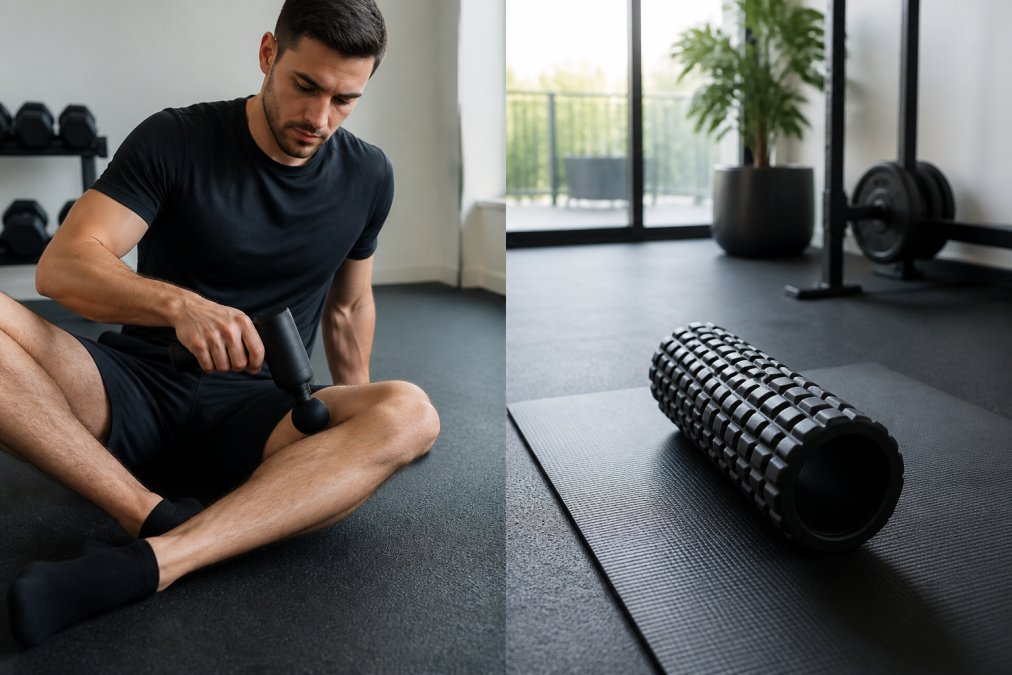
Massage guns deliver rapid percussive therapy to small muscle groups; foam rollers use body weight to apply broad myofascial release across larger areas.
Massage guns target localized tension and knots; foam rollers excel at broad activation and tissue mobilization. Many athletes use both.
Benefits of Percussive Therapy for Muscle Recovery
Percussive therapy uses rapid vibrations to stimulate muscle tissue, improve blood flow, and address DOMS and stiffness more effectively than passive stretching (Checking your browser).
Percussive therapy activates muscle fibers, increases circulation, and breaks up adhesions and knots that limit range of motion.
Injury-Specific Protocols
IT Band Syndrome: Apply to the lateral thigh (not the IT band itself) at moderate intensity for 45-60 seconds, 3-4 times per week. Avoid the knee joint.
Contraindications and Safety Precautions
Avoid massage guns if you have: active inflammation or acute injury (wait 48-72 hours); blood clotting disorders or anticoagulant use; peripheral neuropathy or diabetes-related nerve damage; varicose veins or DVT risk; bone fractures or stress fractures; open wounds, skin infections, or dermatological conditions; or pregnancy.
Optimal Timing and Duration
Use percussive therapy only on healthy muscle tissue. Maximum effective duration is 60-90 seconds per muscle group; longer sessions increase bruising risk without improving results.
Benefits of Foam Rolling for Soreness and Stiffness
Foam rolling applies sustained, controllable pressure to trigger myofascial release, reducing stiffness and improving flexibility.
How to Use a Foam Roller for Soreness: Technique and Application
Position the roller under the target muscle, support yourself with hands or feet, and roll slowly from lower to upper end. Pause 2-3 seconds on tight spots; avoid joints. Spend 30-60 seconds per muscle group, pausing on tender areas to breathe deeply.
Common target areas include:
- Calves: Position roller under your calf, hands behind you for support
- Quadriceps: Roller under your thighs, forearms supporting your upper body
- IT band: Roller under your outer thigh, side-lying position
- Upper back: Roller perpendicular under your upper back, hands supporting your head
- Glutes: Roller under your buttocks, hands and feet supporting weight
| Muscle Group | Duration | Frequency | Best Timing |
|---|---|---|---|
| Calves | 45-60 seconds | 4-5 times per week | Post-workout or evening |
| Quadriceps | 45-60 seconds | 4-5 times per week | Post-workout or evening |
| IT Band | 60-90 seconds | 3-4 times per week | Post-workout or evening |
| Upper Back | 45-60 seconds | 4-5 times per week | Morning or evening |
| Glutes | 60-90 seconds | 4-5 times per week | Post-workout or evening |
Massage Gun vs Foam Roller for Warm-Up and Pre-Workout Prep
For warm-up, use foam rollers (30 seconds per area) to activate muscles and boost blood flow, or massage guns (15-30 seconds per group) to target specific stiffness. Most athletes combine both: light foam rolling for general activation, then targeted massage gun use on tight areas.
Muscle Recovery Duration: What to Expect from Each Tool
Massage gun effects are immediate but temporary (30 minutes to 2 hours), making them ideal for quick between-workout relief. Foam rolling produces cumulative benefits over 2-3 weeks of consistent use, improving tissue elasticity and range of motion. For DOMS, massage guns provide faster acute relief; foam rolling supports healing over the broader 3-5 day recovery period.
Cost Comparison and Long-Term Value
A true cost comparison must account for durability, maintenance, and actual usage frequency.
Foam Roller: Initial Cost and Long-Term Economics
A quality foam roller costs $30-80 and lasts 3-5 years ($0.02-0.05 per day). Maintenance is negligible, occasional soap and water cleaning. Total 5-year cost: $30-80.
Massage Gun: Initial Cost and Hidden Expenses
Massage guns range from $100-400. Beyond initial purchase, budget for battery replacement ($30-80 every 2-3 years) and attachment heads ($15-30 each). 5-year cost for 3-4 times weekly use: ~$280 ($0.15/day). Daily users: ~$390 ($0.21/day).
Decision Framework: Which Tool Offers Better Value for Your Situation
Choose a foam roller if:
- Your budget is under $100 and you want the lowest cost-per-day recovery tool
- You plan to use the tool 3-4 times per week or less (maintenance costs stay near zero)
- You want a tool that requires zero maintenance and will last 5+ years without degradation
- You're building a recovery routine and want to start with the most affordable option
- You have limited storage space and want a single tool that addresses your entire body
Choose a massage gun if:
- You have specific trigger points or muscle knots that foam rolling doesn't address effectively
- You need quick recovery between workouts (15-30 second sessions vs. 10-15 minute foam rolling sessions)
- You plan to use it daily and can justify the higher per-day cost for convenience
- You're willing to budget for battery replacement every 2-3 years
- You have the disposable income to absorb the higher initial investment
Choose both tools if:
- You're a serious athlete or fitness enthusiast who trains 5+ days per week
- You have multiple problem areas that benefit from targeted percussion therapy
- You want to optimize recovery across different phases (warm-up with foam roller, targeted relief with massage gun, cool-down with foam roller)
- Your recovery budget allows for $250-350 initial investment plus $30-50 annual maintenance
Real-World Cost Scenarios
Scenario 1: Casual Fitness Enthusiast (3 workouts per week)
- Foam roller only: $50 initial, $0 maintenance = $50 total investment
- Massage gun only: $200 initial, $50 battery (year 3) = $250 total investment
- Both tools: $50 + $200 = $250 total investment
- Recommendation: Foam roller alone offers best value; add massage gun later if specific needs emerge
Scenario 2: Serious Athlete (5-6 workouts per week)
- Foam roller only: $60 initial, $0 maintenance = $60 total investment
- Massage gun only: $250 initial, $80 battery (year 2), $60 battery (year 4) = $390 total investment
- Both tools: $60 + $250 = $310 total investment
- Recommendation: Both tools justify the investment; the massage gun's convenience for daily use offsets higher cost
Scenario 3: Professional Athlete or Trainer (Daily use)
- Foam roller only: $75 initial, $0 maintenance = $75 total investment
- Massage gun only: $300 initial, $100 battery (year 2), $100 battery (year 4) = $500 total investment
- Both tools: $75 + $300 = $375 total investment
- Recommendation: Both tools are essential; the massage gun becomes a business expense with clear ROI
Which Tool Should You Choose?
The answer depends on your recovery goals, available time, and problem areas.
Frequently Asked Questions
Is a massage gun as effective as a foam roller for muscle recovery?
Both tools support muscle recovery through different mechanisms. Massage guns deliver percussive therapy with rapid vibrations that increase blood flow and reduce muscle activation tension quickly, often within 30-60 seconds per area. Foam rollers apply sustained pressure for myofascial release, addressing tissue density and adhesions over longer sessions. Effectiveness depends on your recovery goal: massage guns excel at rapid post-workout soreness reduction, while foam rollers provide deeper, broader muscle relief over time. Many athletes use both for complementary benefits.
What are the main benefits of percussive therapy?
Percussive therapy from massage guns stimulates muscle activation and increases localized circulation quickly. It reduces delayed onset muscle soreness (DOMS) by promoting blood flow to fatigued muscles and can improve range of motion when used consistently. The vibration frequency triggers a neuromuscular response that helps relax tight muscle fibers and can break up muscle knots. Sessions are typically short (1-2 minutes per area), making it ideal for busy schedules.
Should I use a massage gun or foam roller first in my recovery routine?
For post-workout recovery, start with a massage gun (1-2 minutes per muscle group) to increase blood flow and reduce immediate soreness, then follow with foam rolling for 30-60 seconds per area to address deeper tissue and improve flexibility. This sequence optimizes both acute soreness relief and sustained myofascial release. For warm-up preparation, reverse the order: light foam rolling first to activate muscles and improve range of motion, then brief massage gun use to elevate heart rate and prepare tissues for exercise.
How long does muscle recovery take with these tools?
Massage guns typically reduce acute soreness within 24-48 hours when used daily post-workout, though full muscle recovery (tissue repair and strength restoration) takes 48-72 hours depending on workout intensity. Foam rolling supports recovery over the same timeframe but requires consistent use (3-5 times weekly) to see cumulative benefits in flexibility and tissue health. Neither tool speeds up the actual biological recovery process; both manage symptoms and improve circulation. Combining both tools may optimize the timeline by addressing different recovery pathways simultaneously.
Recovery doesn't have to mean expensive treatments or long sessions in a clinic. The right combination of tools, foam rollers, massage guns, and complementary therapies like light therapy, delivers professional-level recovery from home. TheCoolVibeShop's 60-day money-back guarantee lets you test recovery solutions risk-free. Shop our complete recovery collection today and experience the difference consistent, accessible recovery makes in your training and performance.