How to Fix Locked Shoulder Muscles from Desk Work

Table of Contents
- Why Desk Work Locks Up Your Shoulder Muscles
- How to Fix Muscle Knots Fast with Targeted Release Techniques
- Daily Stretching Routine to Unlock Tight Shoulders
- How Long to Hold Shoulder Stretches for Real Relief
- Ergonomic Desk Setup for Shoulder Pain That Actually Works
- At-Home Tools That Speed Up Recovery
- When to See a Doctor for Locked Shoulder Muscles
- Frequently Asked Questions
Last Updated: September 11, 2026
Why Desk Work Locks Up Your Shoulder Muscles
To fix locked shoulder muscles from desk work, start by understanding why they seize up. Locked shoulder muscles are areas of sustained tension and restricted mobility caused by holding one position for hours, which reduces blood flow and leaves muscle fibers stuck in a contracted state.
The mechanics are straightforward. When your arms reach forward to a keyboard, your pectoral muscles shorten while your upper trapezius and shoulder blade stabilizers overwork to hold your head upright. Over weeks, that imbalance becomes your default posture: the joint capsule stiffens, range of motion drops, and end-of-day tightness turns into a shoulder that won't rotate fully.
This guide covers the release techniques, daily stretching routine, and ergonomic fixes that work for desk workers, all in under 15 minutes a day.
How to Fix Muscle Knots Fast with Targeted Release Techniques
Learning how to fix muscle knots fast comes down to two things: releasing the tissue and restoring movement. The fastest results pair a passive release with an active stretch, which is why the two techniques below work together.
Pendulum Stretch
The pendulum stretch is a gentle, gravity-assisted movement that decompresses the shoulder joint. Stand beside a desk or chair, lean forward, and let your affected arm hang straight down. Shift your weight through your feet so the arm swings in small circles, roughly 30 cm across: 10 clockwise, then 10 counterclockwise. The arm stays relaxed; your body does the work, not your shoulder.
This is the safest starting point if your shoulder feels locked or painful, because it introduces gentle movement without loading the joint.
Cross-Body Reach
The cross-body reach targets the back of the shoulder and the rotator cuff. Pull your arm across your chest at shoulder height, hook your other forearm under it just above the elbow, and draw it closer until you feel a stretch at the back of the shoulder. Hold 30 seconds, breathe, release. Three reps per side is enough.
A common mistake is shrugging the shoulder up toward the ear during this stretch. Keep the shoulder blade pulled down and back.
Daily Stretching Routine to Unlock Tight Shoulders
A short daily routine beats an occasional long one. The sequence below takes about eight minutes and covers the front, back, and underside of the shoulder, where desk workers accumulate the most tension. But the full routine is only half the plan, the other half is a set of micro-stretches you can do without leaving your chair, which is what separates a routine that sticks from one you abandon by week two.
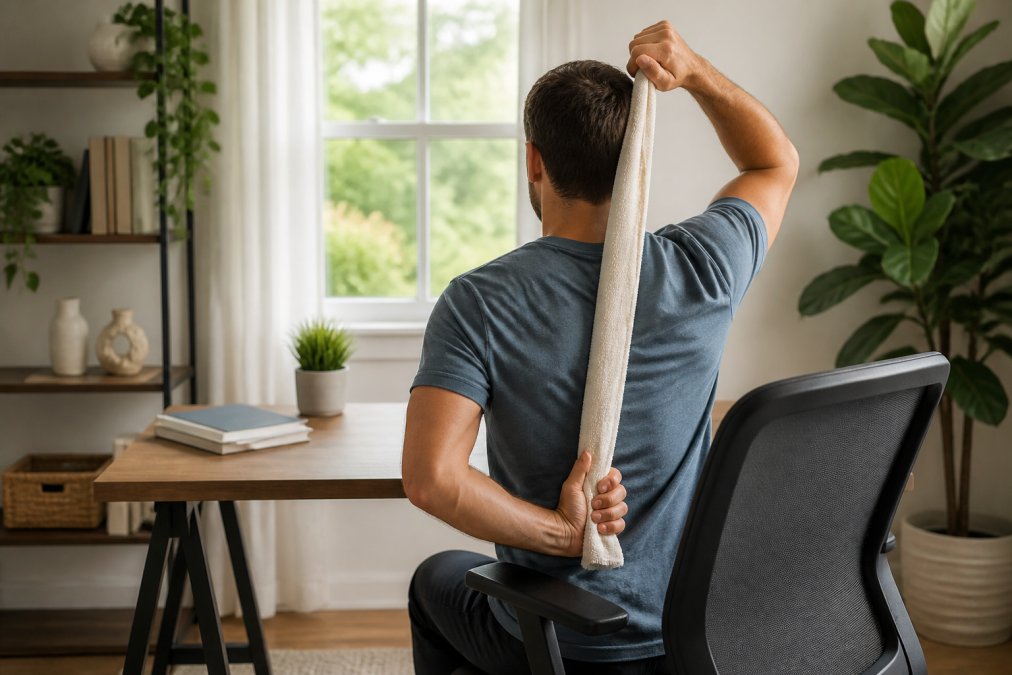
The Full Routine (Once a Day)
Towel stretch. The towel stretch restores internal rotation, the movement most affected by desk work. Hold a towel behind your back, one hand at your lower back and the other reaching over your shoulder. The top hand gently pulls the towel upward, drawing the lower hand up your spine. Stop at tension, not pain. Hold 30 seconds and switch sides.
Finger walk. The finger walk rebuilds overhead mobility. Face a wall about 15 cm away, place your fingertips at waist height, and walk them upward in small increments until you feel a stretch. Mark how high you reach, then add one or two "steps" each week.
Armpit stretch. The armpit stretch opens the underside of the shoulder. Place your hand on a doorframe or shelf at shoulder height, step forward slightly, and lean away until you feel a stretch through the armpit. Hold 30 seconds.
| Exercise | Time per Side | Frequency | Primary Target |
|---|---|---|---|
| Pendulum stretch | 30 seconds | 2x daily | Joint capsule |
| Cross-body reach | 30 seconds | 2x daily | Rotator cuff |
| Towel stretch | 30 seconds | 1x daily | Internal rotation |
| Finger walk | 60 seconds | 1x daily | Overhead mobility |
| Armpit stretch | 30 seconds | 1x daily | Pectoral muscles |
The Desk-Side Micro-Break Routine (Every 30 to 45 Minutes)
This is the part most clinical guides leave out. You don't need a mat, a band, or a private room, every move below happens in your chair, in work clothes, without anyone noticing. The whole sequence takes about 90 seconds.
- Shoulder rolls. Roll both shoulders up, back, and down in slow circles, 10 times, then reverse for 10 more. This breaks the sustained contraction that builds up while you type.
- Seated cross-body reach. Pull one arm across your chest at shoulder height, hook the other forearm above the elbow, and draw it in for a 15-second hold. Switch sides, the full cross-body reach, compressed for your desk.
- Chin tucks. Draw your chin straight back, not down, as if making a double chin, hold for 5 seconds, release. Repeat 5 times. This counters the forward-head drift that drags your shoulders forward.
- Shoulder blade squeeze. Pull your shoulder blades down and back as if pinching a pencil between them, hold for 5 seconds, release. Repeat 10 times.
- Seated pendulum. Let one arm hang straight down beside your chair and swing it in small circles, 10 each direction, then switch. This gives the joint capsule the same gentle decompression as the standing pendulum without getting up.
Why the Micro-Breaks Do the Heavy Lifting
The full routine lengthens tissue; the micro-breaks prevent it from re-locking. Desk workers who only stretch once a day often find tightness returns by mid-afternoon, because eight hours of sustained posture undoes eight minutes of stretching. Short movement snacks keep the muscles from ever settling into that locked state.
How Long to Hold Shoulder Stretches for Real Relief
Hold each shoulder stretch for 30 seconds, and repeat two to four times per side. That's long enough for the muscle to move past its initial resistance and genuinely lengthen, but short enough to fit into a workday. Stretches held under 15 seconds mostly tug on the tissue without lasting change.
The warm-up question matters more than most people expect. Cold muscle resists stretching, so spend two minutes on gentle movement first: shoulder rolls, arm swings, or the pendulum stretch. The American Academy of Orthopaedic Surgeons guidance on stretching notes that warming up before stretching improves flexibility and lowers injury risk.
Ergonomic Desk Setup for Shoulder Pain That Actually Works
An ergonomic desk setup for shoulder pain solves the root cause rather than the symptom. Most locked shoulders trace back to a workstation that forces your arms forward and your head down. Fix the setup and daily strain drops dramatically.

But here's what most guides skip: you can't fix a workstation you haven't measured. Before adjusting anything, run a five-minute audit. Grab a tape measure and a mirror, or ask a coworker to photograph you from the side while you type normally.
The Five-Minute Workstation Audit
Work through these checks in order. Each has a target number, so you can tell whether you pass or fail instead of guessing.
- Seat height. Your feet should rest flat on the floor with knees at roughly 90 degrees. If your chair is too high, your feet dangle and your lower back rounds, which pulls your shoulders forward. Too low, and your knees rise above your hips.
- Elbow angle. With your hands on the keyboard, your elbows should sit at about 90 to 110 degrees, upper arms hanging close to your ribs. If your elbows are behind your torso, you're reaching, and your shoulders are paying for it.
- Monitor distance and height. The screen should sit about an arm's length away, with the top edge at or just below eye level. Measure it: hold your arm straight out and your fingertips should just about touch the screen.
- Armrest position. Set armrests so your shoulders drop down and back, not shrugged toward your ears. If your shoulders ride up when your elbows rest, the armrests are too high.
- Keyboard and mouse placement. Both should sit close enough that you don't reach forward. If your wrists rest on the desk edge while typing, the keyboard is too far away.
A quick side-photo test catches what the tape measure misses. In a good setup, your ear, shoulder, and hip line up roughly vertically from the side. If your head juts forward of your shoulder, or your shoulder sits ahead of your hip, that forward drift loads your upper trapezius all day.
The Occupational Safety and Health Administration's computer workstation guidance recommends positioning the keyboard and mouse so the shoulders remain relaxed and the upper arms hang naturally at your sides, the audit above just gives you the numbers to actually hit that position.
What to Fix First If You Can Only Change One Thing
If you can't overhaul your whole setup, start with monitor height. A screen that sits too low is the most common cause of the forward-head, rounded-shoulder posture that locks up desk workers. Stack books under the monitor or raise it on a stand until the top edge meets eye level, then re-check your elbow angle, raising the screen often lets you sit back, fixing the shoulders as a side effect.
Posture Breaks Matter as Much as Setup
Even a perfect workstation becomes a problem if you hold one position for hours. Stand and roll your shoulders every 30 to 45 minutes. A two-minute micro-break every half hour does more for shoulder mobility than one long stretch at day's end, because it interrupts the sustained contraction before the muscle fibers settle into a locked state.
At-Home Tools That Speed Up Recovery
Heat, massage, and light-based therapy all help a locked shoulder relax faster between stretching sessions by increasing circulation and reducing the tension that makes stretching uncomfortable.
For targeted relief, the Cordless Red Light Therapy for Neck Shoulder Pain Relief combines 660nm red light and 850nm infrared light in a rechargeable, cordless unit designed for the neck, shoulders, and upper back. It's a drug-free option for daily use.
If you prefer a wrap-style device, the Topcupro 4-in-1 Red Light Therapy Wrap works across the shoulder, elbow, knee, and ankle, with one-touch controls and a 20-minute auto shutoff. At $154.99, it's the more flexible pick if you have stiffness in more than one joint.

For direct muscle tension, the Neck Massager with Heat uses low-frequency pulse technology with 50 intensity levels and constant heat between 100.4°F and 107.6°F. It's cordless, so you can use it at your desk. The Wood Therapy Handheld Massage Stick provides firmer manual pressure for the upper trapezius and back.

A common mistake is buying a device and using it for a week. Consistency produces results. TheCoolVibeShop backs every order with a 60-day money-back guarantee, so you can test a routine without risk.
When to See a Doctor for Locked Shoulder Muscles
Most desk-related shoulder tightness improves within two to four weeks of consistent stretching and ergonomic changes. See a doctor for pain that wakes you at night, weakness in the arm or hand, numbness or tingling, or a shoulder that won't move at all in one or more directions.
Those signs can point to something beyond muscular tension, including a rotator cuff injury, impingement, or adhesive capsulitis, sometimes called frozen shoulder. A clinical diagnosis matters because these conditions need a different treatment path than stretching alone. The National Institute of Arthritis and Musculoskeletal and Skin Diseases overview of shoulder problems outlines when shoulder pain warrants professional evaluation.
The psychological side matters too. Chronic pain wears people down, and the frustration of a shoulder that won't loosen can feed stress, which increases muscle tension. Breaking that cycle often means addressing sleep, stress, and movement together rather than chasing a single fix.
A locked shoulder rarely resolves on its own, and the desk that caused it will keep causing it until you change something. TheCoolVibeShop offers non-invasive, drug-free tools designed for exactly this problem: red light therapy devices built for the neck and shoulders, a 4-in-1 wrap that adapts to multiple joints, and a heated neck massager you can use without leaving your chair. Every order comes with a 60-day money-back guarantee. Get started with TheCoolVibeShop and build a daily recovery routine that finally loosens the tension desk work creates.
Frequently Asked Questions
How do you release a locked shoulder?
Start with gentle pendulum swings to reduce tension, then move into a towel stretch and cross-body reach. Apply heat for 10-15 minutes before stretching to loosen the joint capsule. If stiffness persists beyond two weeks, see a doctor or physical therapist for a clinical diagnosis and a tailored rehabilitation plan.
How to relieve shoulder pain from desk job?
Take micro-breaks every 30 minutes to roll your shoulders and stretch your upper trapezius. Adjust your chair so elbows rest at 90 degrees and your monitor sits at eye level. A consistent ergonomic setup for shoulder pain, combined with daily stretching, reduces musculoskeletal strain and prevents stiffness from building up.
Is mouse shoulder permanent?
No, mouse shoulder is not permanent in most cases. It develops from repeated strain on the rotator cuff and deltoid muscles. With consistent stretching, posture correction, and ergonomic adjustments, most people recover fully. Ignoring it for months can lead to chronic pain and impingement, so early action matters.
When should I see a doctor for shoulder pain?
See a doctor if pain lasts more than two weeks, limits your range of motion severely, or comes with numbness or weakness. A physical therapist can assess whether you have adhesive capsulitis, impingement, or a muscular imbalance. Early treatment shortens the recovery process and prevents long-term joint damage.