How to Relieve Chronic Neck Tension: 7 Proven Methods

Table of Contents
- What Causes Chronic Neck Tension
- Neck Pain Exercises for Home
- Hot and Cold Therapy for Neck Relief
- Ergonomic Desk Setup for Neck Pain
- Massage and Myofascial Release Techniques
- Mindfulness, Breathing, and Stress Relief
- When to See a Doctor for Neck Pain
- Red Light Therapy and Advanced Recovery Tools
Last Updated: August 16, 2026
What Causes Chronic Neck Tension
Chronic neck tension develops when muscles in the cervical spine remain contracted for extended periods. The trapezius and levator scapulae muscles are particularly vulnerable because they support your head's weight, roughly 12 pounds, throughout the day. Poor posture, repetitive strain, stress, and muscle stiffness compound this problem over time.
Desk work accelerates the issue significantly. When your monitor sits too low or your chair lacks proper support, your neck muscles work overtime to maintain alignment. Stress-induced tension makes this worse; when anxious or focused, you unconsciously tighten your neck and shoulders, creating a feedback loop between mental state and physical tension.
Overworked muscles develop trigger points, small knots of sustained contraction, that restrict your range of motion and create pain signals. This can lead to tension headaches, numbness and tingling in your arms, or cervical strain radiating down your upper back. Understanding what's driving your tension is the first step toward relief.
Neck Pain Exercises for Home
The best approach combines gentle movement with targeted strengthening. These exercises address both immediate tightness and underlying muscle weakness that allows tension to return.
Gentle Stretching Routine
Stretching provides immediate relief by lengthening contracted muscles and improving range of motion. Hold each stretch for 20-30 seconds, breathing steadily. Never bounce or force into pain, you should feel gentle tension, not sharp discomfort.
The neck flexion stretch targets the back of your neck. Sit upright, slowly lower your chin toward your chest, and feel the stretch along your cervical spine. For a deeper stretch, gently place your hands behind your head and apply light pressure.
Lateral neck stretches address tension on the sides of your neck. Sit upright, tilt your right ear toward your right shoulder, and hold. You'll feel the stretch on the left side. Repeat on the opposite side. This counteracts the forward-head posture that develops from screen time.
The shoulder shrug and release sequence combines movement with relaxation. Lift both shoulders toward your ears, hold for two seconds, then release completely. Repeat 10 times. The contrast between tension and relaxation helps your nervous system reset.

Strengthening Exercises
Once you've reduced acute tension through stretching, strengthening prevents it from returning. Weak neck muscles tire quickly, forcing compensatory tension.
Isometric neck exercises provide resistance without movement. Place your hand against your head and push gently without allowing your neck to move. Hold for 5-10 seconds, then release. Repeat in four directions: forward, backward, and both sides.
The neck retraction exercise corrects forward-head posture. Sit upright, gently draw your chin straight back (imagine making a double chin), hold for two seconds, then release. Perform 10-15 repetitions, focusing on control rather than speed.
Resistance band exercises add progressive difficulty as your strength improves. Loop a resistance band around the back of your head and hold the ends. Gently press your head backward against the band's resistance. Start with light resistance and increase gradually over weeks.
Hot and Cold Therapy for Neck Relief
Temperature therapy works through different mechanisms. Cold reduces inflammation and numbs acute pain; heat increases blood flow and relaxes muscle tension.
Cold therapy excels for acute inflammation and sharp pain. Apply cold for 15 minutes at a time, several times daily, using a cloth barrier to protect your skin. Cold therapy is most effective in the first 48 hours after injury or during acute pain flare-ups.
Heat therapy addresses chronic muscle tension and stiffness. Warmth increases circulation, delivering oxygen and nutrients to tight muscles while flushing out metabolic waste. Apply heat for 15-20 minutes at a time using a heating pad, hot shower, or warm compress.
Alternating therapy combines both approaches for optimal results. Start with 15 minutes of cold to reduce inflammation, follow with 15 minutes of heat to promote relaxation and circulation. This cycle can be repeated 2-3 times daily.
Red light therapy offers a modern advancement in recovery. Unlike traditional heat, red light at wavelengths of 660nm and 850nm penetrates tissue deeply without surface heat, stimulating cellular energy production and reducing inflammation at the source. TheCoolVibeShop's Cordless Red Light Therapy for Neck Shoulder Pain Relief ($299.99) delivers both wavelengths to target chronic neck tension effectively. The cordless design lets you apply therapy while working or relaxing, making consistent treatment easier to maintain.

Ergonomic Desk Setup for Neck Pain
Your workstation is either your greatest ally or worst enemy when managing chronic neck tension. Poor ergonomics force your neck muscles into compensation patterns that create or worsen tension.
Monitor height is the single most critical factor. Your eyes should meet the screen at or slightly below the horizontal midline when looking straight ahead. Position your screen at arm's length distance, roughly 20-26 inches from your eyes.
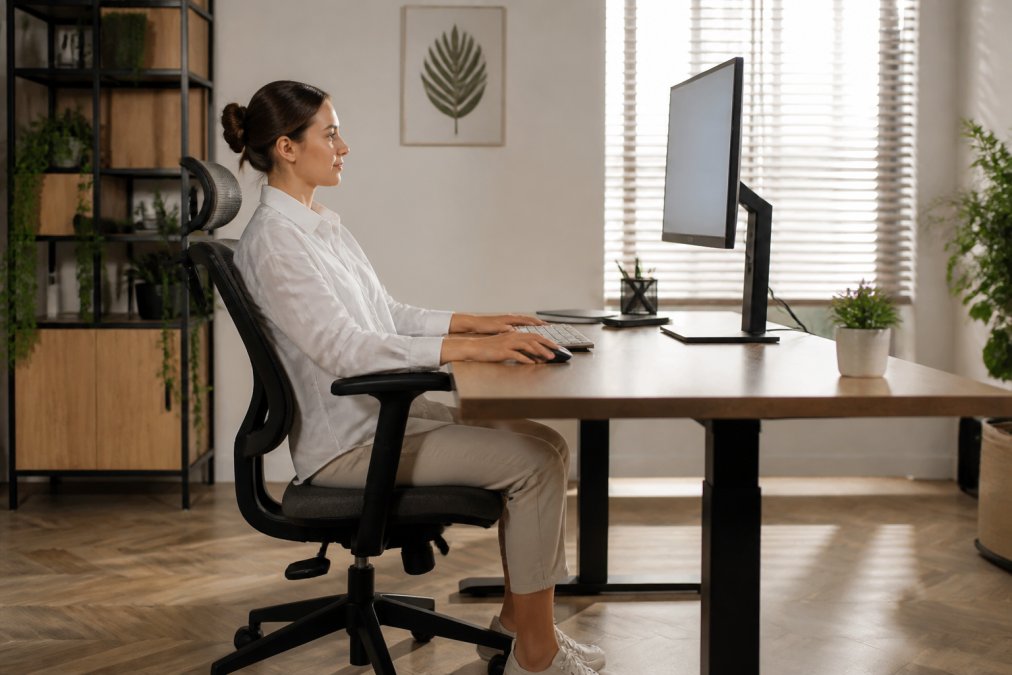
Chair support matters significantly. Your chair should support the natural curve of your cervical spine. Adjust the backrest height to support your upper back and neck. Your shoulders should sit directly above your hips when seated. If your current chair doesn't provide adequate support, a small cervical pillow can help.
Keyboard and mouse positioning prevents repetitive strain. Your elbows should bend at roughly 90 degrees, with your wrists neutral and straight. When your arms are properly positioned, your shoulders stay relaxed, reducing compensatory tension that travels up into your neck.
Desk height should allow your forearms to rest at about 90 degrees when your hands are on the keyboard. If your desk height is fixed, an adjustable keyboard tray can solve the problem affordably.
Take frequent breaks every 30 minutes to interrupt sustained postures. Stand up, stretch, and look away from your screen. Consistent movement prevents tension from accumulating.
Massage and Myofascial Release Techniques
Massage addresses chronic neck tension by breaking up trigger points and improving circulation to tight muscles. Self-massage techniques let you apply treatment on your schedule, while massage devices provide consistent pressure.
Self-Massage Methods
Your hands remain the most accessible massage tool. Use your fingers to locate tender spots in your trapezius and levator scapulae muscles, they'll feel like small knots under the skin. Apply gentle, steady pressure to each trigger point for 30-60 seconds while breathing deeply.
The neck self-massage technique targets the back of your neck. Interlace your fingers behind your head and use your thumbs to apply pressure to the muscles along your cervical spine. Work from the base of your skull down toward your shoulders, pausing at tender areas. This is particularly effective before bed.
Levator scapulae release focuses on the muscle running from your shoulder blade to your neck. Reach your right hand over your head and place your fingers on the left side of your neck where it meets your shoulder. Apply gentle pressure and slowly rotate your head to the right. Repeat on the opposite side.
Using Massage Devices
Massage devices provide consistent pressure and can reach muscles difficult to access with your hands alone. The Neck Massager with Heat and TENS Therapy from TheCoolVibeShop ($97.50) combines multiple therapeutic approaches. TENS (transcutaneous electrical nerve stimulation) technology uses electrical pulses to interrupt pain signals and stimulate muscle relaxation, while heat increases circulation. The 50 intensity levels let you customize pressure to your comfort level.

Handheld massage sticks offer myofascial release without electricity. The Wood Therapy Handheld Massage Stick ($98.99) uses smooth wooden surfaces to apply sustained pressure along your neck and upper back. The design lets you control pressure and angle precisely, making it ideal for targeting specific trigger points.
Consistency matters most. Daily or near-daily use for 10-15 minutes produces noticeable improvement within 2-3 weeks. Combining self-massage techniques with device-based therapy provides the best results.
Mindfulness, Breathing, and Stress Relief
Stress-induced tension accounts for a significant portion of chronic neck tension. Breaking this cycle requires addressing the mental component alongside physical treatment.
Mindfulness meditation teaches your nervous system to recognize and release tension before it becomes chronic. Sit comfortably, close your eyes, and focus on your breath for 10-15 minutes daily. This practice reduces overall tension levels and increases body awareness.
Breathing exercises provide immediate relief during high-stress moments. The 4-7-8 breathing technique activates your parasympathetic nervous system. Inhale for 4 counts, hold for 7 counts, exhale for 8 counts. Repeat 4-5 times. This can reduce neck tension noticeably within minutes.
Progressive muscle relaxation combines tension and release to teach your body what true relaxation feels like. Starting with your neck, tense the muscles for 5 seconds, then release completely. Move through all major muscle groups systematically.
Regular aerobic exercise reduces stress hormones and improves circulation throughout your body. Walking, cycling, or swimming for 30 minutes most days of the week provides measurable relief from chronic neck tension and improves sleep quality.
When to See a Doctor for Neck Pain
Most cases of chronic neck tension improve with consistent self-care, but certain symptoms warrant professional evaluation.
Seek medical attention if you experience numbness and tingling in your arms or hands, which may indicate nerve compression. Severe headaches that accompany neck tension, particularly if new or worsening, deserve professional assessment. Weakness in your arms or hands suggests neurological involvement requiring diagnosis.
Pain that doesn't improve after 2-3 weeks of consistent self-care warrants evaluation. A physical therapist can design a personalized exercise program and assess your posture. A doctor can rule out underlying conditions and recommend appropriate treatment.
Red flag symptoms requiring urgent care include severe headache with neck stiffness, fever, difficulty swallowing, or numbness affecting your entire arm or hand.
Red Light Therapy and Advanced Recovery Tools
Red light therapy represents an evidence-based advancement beyond traditional heat therapy. Wavelengths of 660nm and 850nm penetrate tissue deeply, stimulating mitochondrial function and reducing inflammation at the cellular level.
Red light therapy works by increasing ATP production in muscle cells, providing energy for repair and recovery. Consistent use, typically 10-15 minutes daily, produces cumulative benefits over 2-3 weeks as cells repair and inflammation decreases.
TheCoolVibeShop's Cordless Red Light Therapy for Neck Shoulder Pain Relief ($299.99) delivers dual wavelengths specifically calibrated for neck and shoulder tension. The cordless design means you can use it while working, reading, or relaxing, making consistent daily treatment realistic. The 60-day money-back guarantee removes purchase risk and reflects confidence in the technology.
For comprehensive neck and shoulder relief, combining red light therapy with ergonomic adjustments and consistent stretching produces the fastest results. The Topcupro 4-in-1 Red Light Therapy Wrap ($154.99) provides flexibility for treating multiple areas.

Chronic neck tension doesn't require expensive treatments or medications to improve. The combination of targeted stretches, ergonomic adjustments, and consistent self-care produces measurable relief within weeks. TheCoolVibeShop's red light therapy devices accelerate this process by addressing inflammation at the cellular level while you maintain your daily routine. Start with foundational approaches, stretching and ergonomic setup, then add red light therapy or massage devices as needed. The 60-day guarantee means you can test the approach risk-free and experience the difference that non-invasive, drug-free recovery makes.
Frequently Asked Questions
How long does it take to relieve chronic neck tension?
Relief timelines vary. Gentle stretches and posture adjustments often provide noticeable improvement within 1-2 weeks of consistent practice. Muscle stiffness and inflammation may require 4-6 weeks to fully resolve. Red light therapy and massage devices show cumulative benefits over 2-3 weeks of regular use. If pain persists beyond 6 weeks despite these efforts, consult a healthcare provider.
Can stress cause chronic neck tension?
Yes. Stress triggers muscle tension, particularly in the trapezius and levator scapulae muscles around the neck and shoulders. Stress-induced tension often worsens with poor posture and sedentary work. Combining mindfulness meditation, breathing exercises, and physical activity helps break this cycle. Addressing both the physical tension and underlying stress is key to lasting relief.
What's the difference between heat and cold therapy for neck pain?
Cold therapy reduces inflammation and numbs acute pain, making it ideal for fresh injuries or flare-ups. Heat therapy relaxes muscle stiffness, improves circulation, and eases chronic tension. For chronic neck tension, heat is typically more effective. Apply heat for 15-20 minutes before stretching or exercise. Use cold therapy if inflammation is present or after activity causes soreness.
Are massage devices safe to use every day for chronic neck tension?
Most massage devices are safe for daily use when used as directed. Electric neck massagers with TENS therapy and red light therapy devices are designed for regular application. Start with shorter sessions (10-15 minutes) to assess tolerance, especially if you have sensitive skin or take medications. If you experience numbness, tingling, or increased pain, reduce frequency or consult a healthcare provider.
This article was written using GrandRanker