Red Light Therapy vs Infrared Sauna Benefits Compared

Table of Contents
- Red Light Therapy vs Infrared Sauna Benefits: How the Two Technologies Differ
- Light Energy vs Heat Energy: The Core Split
- Wavelengths, Nanometers, and Therapeutic Depth
- Red Light Therapy Benefits for Skin, Muscles, and Joints
- Infrared Sauna Benefits: Sweat, Circulation, and Cardiovascular Health
- How Long Should You Stay in an Infrared Sauna?
- Combining Red Light Therapy and Heat Therapy: A Practical Protocol
- Contraindications, Medication Interactions, and Medical Screening
- Home vs Professional Equipment: What to Look For
- Frequently Asked Questions
Last Updated: September 30, 2026
Red Light Therapy vs Infrared Sauna Benefits: How the Two Technologies Differ
Red light therapy vs infrared sauna benefits come down to one core split: light energy works on cells, heat energy works on circulation. Picking the wrong one wastes money and time.

Light Energy vs Heat Energy: The Core Split
Red light therapy is a light-based treatment that delivers specific wavelengths to skin, muscle, and joint tissue, while an infrared sauna is a heat-based treatment that warms the body from the inside out. That difference explains everything else, from session length to how each one feels.

How red light therapy actually works
Red light therapy, also called photobiomodulation, sends photons into tissue, where they are absorbed by chromophores inside your cells. The primary target is cytochrome c oxidase (CCO), an enzyme in the mitochondrial membrane. When CCO absorbs a photon at 660nm or 850nm, nitric oxide is displaced, electron transport resumes, and ATP production increases, fueling repair and reducing inflammation.
How an infrared sauna actually works
An infrared sauna emits far-infrared radiant heat, typically in the 5.8 to 15 micron range, absorbed primarily by water molecules in your tissue. As those molecules vibrate faster, tissue warms from the inside out. Core temperature rises, blood vessels widen, and sweat glands activate.
Why the two are not competing on the same axis
| Variable | Red Light Therapy | Infrared Sauna |
|---|---|---|
| Energy type | Photons (light) | Radiant heat |
| Primary target | Mitochondria (CCO enzyme) | Water molecules in tissue |
| Dose metric | J/cm² (fluence) | Temperature + duration |
| Penetration | 1-5 cm depending on wavelength | Whole-body thermal load |
| Systemic effect | Localized, with some systemic signaling | Full-body cardiovascular and thermal |
One targets tissue at the cellular level; the other targets your whole system at the thermal level. Comparing them by wavelength alone is misleading, because a sauna's far-infrared output is heat, not a therapeutic light dose.
Wavelengths, Nanometers, and Therapeutic Depth
Wavelength determines how deep light penetrates tissue, and this is where most marketing claims fall apart.
The three layers that matter:
- Epidermal: the outer surface, where visible red light does most of its work
- Dermal: the middle layer, home to collagen and elastin
- Subcutaneous: the deepest layer, where near-infrared light reaches muscle and joint tissue
Red Light Therapy Benefits for Skin, Muscles, and Joints
The strongest evidence for red light therapy sits in three areas: skin rejuvenation, muscle recovery, and joint comfort. Each relies on the same mechanism, improved mitochondrial function and reduced oxidative stress.
Collagen, Fine Lines, and Skin Rejuvenation
Red light therapy benefits for skin center on collagen production: when dermal cells absorb red light, they increase collagen and elastin output over consistent use. That is why fine lines and skin texture are the most common reasons people start. What most guides miss is the timeline: skin changes take weeks of regular sessions, not days.
Muscle Recovery, Joint Pain, and Inflammation Reduction
For muscle recovery, near-infrared light reaches deeper tissue to support repair and reduce inflammation. Athletes and gym-goers use it after training to ease soreness. For joint pain, light delivered to the joint area supports localized treatment without drugs or downtime.
Infrared Sauna Benefits: Sweat, Circulation, and Cardiovascular Health
Infrared sauna benefits come from heat stress, which raises heart rate, widens blood vessels, and triggers a deep sweat response. The cardiovascular effect is the headline: your heart works harder while you sit still, similar to mild exercise.
The main benefits people report:
- Vasodilation and improved circulation
- Sweat response and systemic detoxification through the skin
- Cardiovascular health support through heat-induced cardiac load
- Deep relaxation that many find easier to reach than through light therapy
- Muscle relaxation from sustained warmth
How Long Should You Stay in an Infrared Sauna?
Most people should start at 10 to 15 minutes and build toward 20 to 30 minutes per session, three to four times per week. Longer is not better, especially at first. Jumping straight into 40-minute sessions is the fastest way to feel dizzy or dehydrated.
A practical progression:
Full Body Red Light Therapy Mat →
| Week | Session Length | Frequency | Focus |
|---|---|---|---|
| Week 1 | 10-15 minutes | 2-3 times | Adaptation |
| Week 2-3 | 15-20 minutes | 3 times | Comfort and sweat response |
| Week 4+ | 20-30 minutes | 3-4 times | Full benefit window |
Combining Red Light Therapy and Heat Therapy: A Practical Protocol
Combining red light therapy and heat therapy works best when you sequence them: light first, heat second, with a short gap between.
Here is a protocol that fits a normal evening:
- Red light therapy session: 10 to 20 minutes on the target area, using a mat, wrap, or belt depending on the body part.
- Rest and hydrate: 10 to 15 minutes. Let your body settle.
- Heat session: 15 to 25 minutes in an infrared sauna, or a warm shower if you do not own one.
- Cool down: 5 minutes at room temperature before bed.
Contraindications, Medication Interactions, and Medical Screening
Both treatments are generally well tolerated, but neither is right for everyone, and screening yourself first is not optional. This matters most if you have a medical condition, take medication, or are pregnant.
Red light therapy: who needs to be cautious
Red light therapy is non-ionizing and does not burn tissue, but it is not risk-free for everyone. The main concerns are photosensitivity and light-triggered conditions.
- Photosensitizing medications. Certain antibiotics (tetracyclines, fluoroquinolones), acne treatments (isotretinoin), diuretics, and some antidepressants can make your skin react more strongly to light. The reaction is usually mild, redness or irritation, but it is worth flagging.
- History of skin cancer or active lesions. Light therapy should not be used directly over suspicious moles, active skin cancer, or broken skin without oncologist clearance.
- Photosensitivity disorders. Lupus, porphyria, and polymorphic light eruption can be triggered or worsened by light exposure.
- Pregnancy. Red light therapy is generally considered low-risk, but most practitioners recommend avoiding abdominal treatment during pregnancy because the evidence base is thin.
- Retinal conditions. Never look directly into a red light panel without protective eyewear. If you have a retinal condition, ask your eye doctor before using a full-body mat.
- Implanted electronic devices. Pacemakers and defibrillators are not known to be affected by red light, but do not place a panel directly over the device without medical clearance.
Infrared sauna: who needs to be cautious
The heat load is the main concern with infrared saunas: your cardiovascular system works harder to dissipate heat, which is not safe for everyone.
- Cardiovascular conditions. Heart disease, uncontrolled hypertension, recent heart attack or stroke, and arrhythmias all make heat stress risky. Some cardiologists use sauna therapy deliberately in supervised settings, but that is a clinical decision, not a home one.
- Blood pressure medication. Diuretics, beta-blockers, and vasodilators can amplify the drop in blood pressure that happens when you stand up after a sauna. Dizziness and fainting are the real risks here.
- Pregnancy. Most obstetricians advise against sauna use during pregnancy, particularly in the first trimester, because core temperature elevation is associated with neural tube defects.
- Impaired temperature sensation. Diabetes-related neuropathy, spinal cord injuries, and certain neurological conditions can blunt your ability to feel when you are overheating.
- Medications that affect sweating. Anticholinergics, some antipsychotics, and certain antihistamines reduce your ability to sweat, which is your body's primary cooling mechanism.
- Alcohol or recreational drug use before a session. Both impair thermoregulation and judgment. Do not combine them with sauna use.
- Open wounds, acute injuries, or recent surgery. Heat increases blood flow and swelling. Wait for clearance.
A simple screening checklist
Before your first session of either therapy, run through these questions:
- Am I pregnant, or trying to become pregnant?
- Do I take any medication that lists photosensitivity or heat intolerance as a side effect?
- Do I have a heart condition, uncontrolled blood pressure, or a history of fainting?
- Do I have any active skin lesions, moles that have changed, or a history of skin cancer?
- Do I have a condition that affects my ability to feel or regulate temperature?
- Do I have an implanted electronic device?
Home vs Professional Equipment: What to Look For
Home devices have closed most of the gap with professional equipment, and for daily use, home usually wins on consistency. Consistency drives results, not peak power.
What to check before buying:
- Wavelength accuracy: look for stated 660nm and 850nm output, not vague "red light" claims
- Power density: measured in mW/cm², and higher is not automatically better for skin
- Treatment area: a mat covers the body, a wrap or belt targets one joint
- Session timer: built-in timers prevent overuse
- Return policy: a real trial period matters more than any spec sheet
Which TheCoolVibeShop device fits your goal?
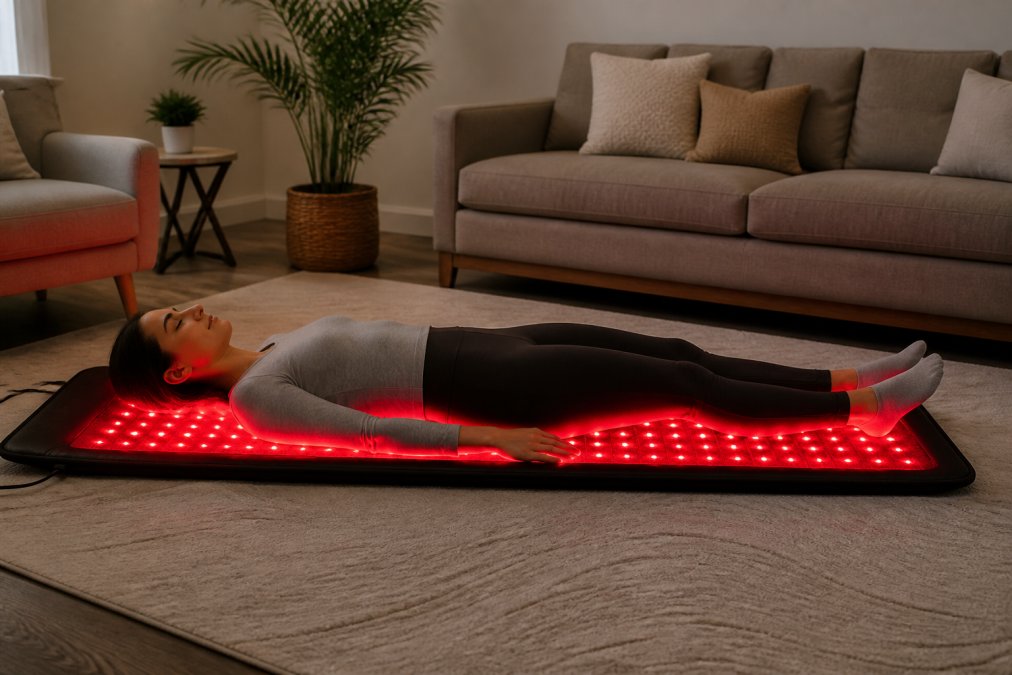
If you want full-body coverage, the Full Body Red Light Therapy Mat uses red and near-infrared light across a generous surface, and it suits post-workout recovery and daily relaxation.
Frequently Asked Questions
Can you do red light therapy and infrared sauna together?
Yes, and many people sequence them in one session. A common approach is 10 to 20 minutes of red light therapy first, targeting specific areas like the neck, shoulders, or lower back, followed by 15 to 30 minutes in an infrared sauna. Red light works on the skin and tissue directly beneath it, while infrared heat raises core temperature and drives a sweat response. Doing light first means the heat does not interfere with your targeted treatment window. Hydrate before and after, and keep total heat exposure under 40 minutes.
Which is better for muscle recovery: red light therapy or infrared saunas?
They work differently, so the better choice depends on what you need. Red light therapy delivers near-infrared wavelengths that reach muscle tissue and support cellular energy, mitochondrial function, and inflammation reduction at the treatment site, which suits a sore shoulder, knee, or lower back. Infrared saunas raise your whole-body temperature, increase blood flow through vasodilation, and produce a systemic sweat response. For a single locked-up area, targeted red light therapy is more direct. For full-body relaxation and circulation after a hard training week, an infrared sauna fits better.
What is the downside of red light therapy?
The main downsides are time commitment and consistency. Sessions typically run 10 to 20 minutes, several times per week, and results build gradually rather than overnight. Some people notice mild skin warmth or redness right after use. Anyone taking photosensitizing medications, including certain antibiotics and acne treatments, should check with a doctor before starting. Red light therapy is not a treatment for a diagnosed medical condition, and it does not replace care from a physician for an injury or chronic disease.
Are there specific health risks associated with infrared saunas?
Infrared saunas raise body temperature, so dehydration and overheating are the main concerns. Sessions should stay in the 15 to 30 minute range, and longer is not better. Skip sauna use if you are pregnant, have uncontrolled blood pressure or heart conditions, or take medication that affects sweating or temperature regulation. Avoid alcohol before or during a session. If you feel dizzy, lightheaded, or nauseated, exit immediately and cool down. People with diabetes should check with a doctor first because heat can affect circulation and blood sugar.
How do the mechanisms of action differ between light therapy and heat therapy?
Red light therapy uses specific wavelengths, commonly 660 nanometers for surface skin and 850 nanometers for deeper tissue, to support ATP production and cellular energy in the cells that absorb the light. Infrared saunas work through thermal stress: the heat raises your core temperature, triggers vasodilation, increases metabolic rate, and produces a sweat response that supports systemic detoxification. One is a localized light-based treatment, the other is a whole-body heat exposure. That difference explains why the benefits overlap in some areas and diverge in others.