How Long for Red Light Therapy Results? Timeline

Table of Contents
- The Short Answer: Red Light Therapy Results Timeline
- Why Results Take Time: The Biology of Photobiomodulation
- Red Light Therapy Benefits Timeline by Week
- Red Light Therapy Frequency for Best Results
- Key Factors That Speed Up or Slow Down Your Progress
- Best Practices for Red Light Therapy Sessions
- Managing Plateaus and Tracking Your Progress
- Conclusion: Commit to the Process
- Frequently Asked Questions
Last Updated: September 9, 2026
The Short Answer: Red Light Therapy Results Timeline
Most people ask how long for red light therapy results to appear, and the honest answer is that visible changes typically take 4 to 12 weeks of consistent use (peer-reviewed research). Red light therapy is a cumulative process where each session builds on the previous one, so sporadic use will not produce the outcomes you are looking for. The timeline depends heavily on your goals: superficial skin improvements often appear sooner, while deeper structural changes in tissue require more patience.

Red light therapy results are not immediate because the treatment works at a cellular level rather than a surface level. The wavelengths penetrate the skin and stimulate biological processes that take time to unfold (the NIH). Understanding this fundamental point helps set realistic expectations before you begin your first session.
Why Results Take Time: The Biology of Photobiomodulation
Photobiomodulation is the scientific term for what red light therapy does: it delivers specific wavelengths of light, typically 660nm red and 850nm near-infrared, to your cells. These wavelengths are absorbed by mitochondria, the energy-producing structures within your cells, which then increase ATP production. Higher ATP means more cellular energy available for repair, collagen synthesis, and inflammation reduction.
This biological mechanism explains why results are gradual. Your body does not rebuild collagen or remodel tissue overnight. The therapeutic window requires repeated exposure over weeks to trigger measurable changes in the dermal layer and deeper structures. A clinical perspective from the National Institutes of Health library on photobiomodulation research confirms that treatment protocols rely on cumulative dosing to achieve meaningful biological effects.
The key distinction is between immediate sensory effects and structural changes. You may feel relaxed or notice temporary warmth after a session, but actual tissue repair operates on a slower clock. Epidermal turnover alone takes roughly 28 days, and collagen remodeling spans several months.
Red Light Therapy Benefits Timeline by Week
| Timeframe | What You May Notice | What Is Happening |
|---|---|---|
| Week 1-2 | Subtle relaxation, possible improvement in skin tone | Cellular energy increases; inflammation begins to drop |
| Week 3-4 | Slightly smoother texture, reduced redness or erythema | Collagen synthesis ramps up; epidermal turnover accelerates |
| Week 5-8 | More visible changes in fine lines and skin elasticity | Structural remodeling in the dermal layer gains momentum |
| Week 9-12 | Noticeable results for most users | Tissue repair and collagen density reach meaningful levels |
| Week 12+ | Maintenance phase begins | Results stabilize with reduced session frequency |
During the first month, the changes are often too subtle for anyone but you to notice. Skin texture may feel slightly smoother, and muscle soreness after workouts may resolve faster. The real transformation happens between weeks 6 and 12, when collagen production has compounded enough to create visible differences in fine lines, skin elasticity, and overall tone.
Red Light Therapy Frequency for Best Results
The red light therapy frequency for best results follows a clear pattern: most protocols recommend 3 to 5 sessions per week during the initial phase. Each session typically lasts 10 to 20 minutes depending on the device and treatment area. Consistency matters more than duration, meaning five shorter sessions spread across a week outperform two marathon sessions.
For muscle and joint recovery, daily use is generally safe and often recommended during acute phases. For facial anti-aging goals, every other day allows the skin adequate recovery time between sessions. A common mistake is overdoing sessions in the first week, then burning out by week three. Steady, predictable scheduling produces the best adherence and therefore the best outcomes.
Key Factors That Speed Up or Slow Down Your Progress
Several variables determine how quickly you see red light therapy results, and understanding them helps you optimize your protocol. The most critical, and most misunderstood, factor is device power density, also known as irradiance. This is measured in milliwatts per square centimeter (mW/cm²) and dictates how much light energy actually reaches your target tissue in a given session.
Most clinical studies that show positive results use devices with an irradiance of 20 to 100 mW/cm² at the skin surface. A device with low irradiance (e.g., 10 mW/cm²) may require significantly longer sessions to deliver the same total energy dose as a higher-powered device. For example, a 10-minute session at 50 mW/cm² delivers 30 Joules/cm² of energy, while a device at 25 mW/cm² would need 20 minutes to achieve the same dose. This is why comparing session times alone is misleading, you must compare the total energy delivered, not just the minutes logged.
Your specific concern also sets the timeline. Superficial issues like skin tone and fine lines respond faster than deeper conditions such as joint stiffness or scar tissue remodeling. Near-infrared wavelengths (850nm) penetrate deeper than red (660nm), so a device that emits both will address different tissue depths in the same session.
Skin type is another variable that most guides overlook. Melanin, the pigment in skin, absorbs visible light, including red wavelengths. Individuals with darker skin tones (Fitzpatrick types IV-VI) may require slightly higher energy doses or longer sessions to achieve the same cellular response as those with lighter skin. This does not mean the therapy is ineffective, it simply means the protocol may need adjustment. Age also plays a role, since cellular metabolism and collagen production naturally slow over time, often extending the timeline for visible results in older adults.
Consistency is the factor entirely within your control. Missing sessions extends your timeline proportionally, and patient compliance is the strongest predictor of success in any light therapy protocol. Consistency is the factor entirely within your control. Missing sessions extends your timeline proportionally, and patient compliance is the strongest predictor of success in any light therapy protocol.
Best Practices for Red Light Therapy Sessions
Establishing a routine that supports consistency requires attention to a few practical details. Clean the treatment area and your skin before each session so nothing blocks the light from reaching target tissues. Position the device at the recommended distance, typically a few inches from the skin for handheld units or direct contact for wrap-style devices.
Timing your sessions matters as much as frequency. Morning sessions can energize cellular metabolism for the day, while evening sessions support recovery and relaxation before sleep. Keep a simple log of your sessions, noting date, duration, and any changes you observe. This documentation helps you spot patterns and stay motivated during the early weeks when visible changes are minimal.
Managing Plateaus and Tracking Your Progress
Most users hit a plateau between week 6 and week 10, where progress seems to stall despite consistent use. This is normal and does not mean the therapy has stopped working. Your body is consolidating earlier gains, and visible changes often arrive in bursts rather than linear progression. However, a true plateau that extends beyond 2-3 weeks warrants a protocol review.
Here is a systematic approach to breaking through a stall:
1. Audit your energy dose. If you have been using the same session duration since day one, your total energy delivery may be insufficient for the remodeling phase. If you have been using the same session duration since day one, your total energy delivery may be insufficient for the remodeling phase. Do not exceed 20 minutes per area unless your device manual explicitly allows it.
2. Check device output degradation. LED chips lose potency over time. LED chips lose potency over time. If your device is older and you have not noticed any change, verify the output with a power meter if available, or contact the manufacturer for a performance check.
3. Vary your treatment window. If you always treat in the morning, switch to evening for 2 weeks. Circadian rhythms influence mitochondrial activity, and some users respond better to evening sessions when cellular repair processes are naturally more active.
4. Re-evaluate your target area. If you are treating a chronic condition like joint pain or scar tissue, the initial inflammatory phase may have resolved, but deeper structural remodeling takes longer.
5. Add a deload week. Paradoxically, taking 3-4 days off can break a plateau. This allows the tissue to complete its inflammatory resolution cycle without constant stimulation.
To track progress effectively, avoid daily mirror checks. Instead, use objective markers:
- Weekly photos in the same lighting, angle, and time of day. Store them in a dedicated album so you can compare side-by-side.
- Skin texture mapping, run your fingers across the treatment area and note roughness or elasticity changes on a 1-10 scale weekly.
- Recovery time logs for muscle soreness or joint stiffness, record how many hours or days it takes to feel normal after a workout.
Conclusion: Commit to the Process
Red light therapy rewards those who treat it as a long-term wellness practice rather than a quick fix. The science of photobiomodulation is clear: cellular energy, collagen synthesis, and tissue repair all require repeated exposure over weeks to produce visible change. Whether your goal is smoother skin, reduced muscle soreness, or joint relief, the path is the same.
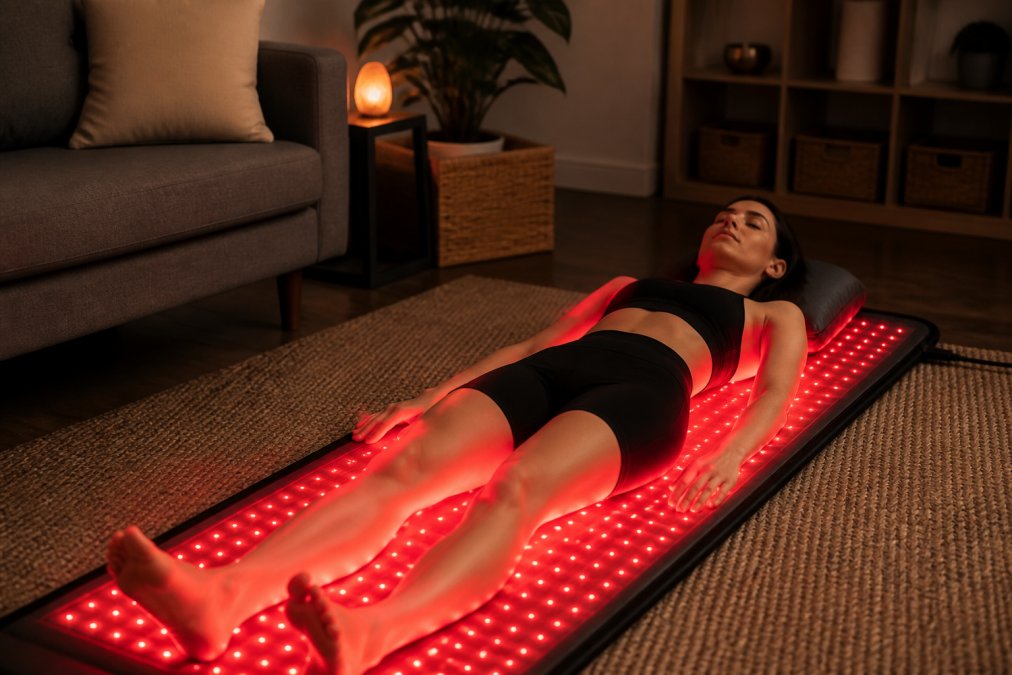
TheCoolVibeShop offers modern red light therapy solutions designed for safe, everyday home use, backed by a 60-day money-back guarantee so you can commit with confidence. Our full body red light therapy mat delivers consistent coverage for whole-body sessions, while targeted options like the cordless neck and shoulder device address specific problem areas. With 1,500+ satisfied customers and a non-invasive, drug-free approach, the only real requirement is showing up consistently.

Get started with TheCoolVibeShop and give your cells the time they need to deliver the results you deserve.
Frequently Asked Questions
Can I use red light therapy while taking antibiotics?
Some medications can make your skin more sensitive to light. If you are taking antibiotics, particularly tetracyclines, consult your doctor before starting red light therapy sessions. Your healthcare provider can confirm whether your specific medication interacts with light exposure and advise on a safe red light therapy frequency for best results.
How many weeks of red light therapy does it take to see results?
Most people notice early changes in skin tone and texture within 2 to 4 weeks of consistent use. Deeper structural changes, such as improved collagen synthesis for fine lines or significant joint relief, typically require 8 to 12 weeks. Consistency is the most critical factor in achieving the full red light therapy benefits timeline.
Do red light therapy results happen immediately?
You may feel temporary relaxation or a warm sensation after your first session, but visible biological changes are not immediate. Red light therapy works by stimulating cellular energy production, a process that takes time to build. Expect gradual, cumulative improvements rather than instant fixes, and stick with a consistent schedule to see lasting red light therapy results.
Can you overdo red light therapy while waiting for results?
Yes. Using a device for longer than the manufacturer's recommended session time does not speed up results and can cause skin irritation or erythema. It is safer to follow the protocol precisely. Consistency matters more than intensity, so stick to the suggested duration and frequency rather than adding extra sessions.