Effective Relief for Shoulder Tension: 7 Steps

Table of Contents
- What Causes Shoulder Tightness and When to Seek Help
- Stretches for Shoulder Tightness That Work Fast
- How to Fix Muscle Knots Fast Using Self-Massage
- Benefits of Red Light Therapy for Muscle Recovery
- Heat and Cold Therapy: When and How to Use Each
- Desk Ergonomics and Posture Correction for Daily Relief
- Sleep Position and Recovery Optimization
- Conclusion
Last Updated: August 26, 2026
What Causes Shoulder Tightness and When to Seek Help
Shoulder tightness develops when muscles in the neck, upper back, and shoulder region become tight and restricted. The most common culprits are prolonged sitting, repetitive overhead movements, stress-induced muscle tension, and poor posture that forces your shoulders toward your ears. Your trapezius and rhomboids, the large muscles across your upper back, bear the brunt of this tension, especially when you spend hours hunched over a desk.
The distinction between normal muscle tightness and something requiring medical attention matters. Mild shoulder tightness that responds to stretching and self-massage within a few days is typically muscular. Seek professional help if you experience sharp, shooting pain, numbness or tingling down your arm, weakness that prevents normal movement, or tightness accompanied by swelling (the NIH). These can signal rotator cuff issues, nerve compression, or shoulder impingement that needs clinical evaluation.
Many office workers dismiss shoulder tightness as inevitable. It's not. Understanding what triggers your specific tension, whether it's desk posture, stress, or muscle imbalances, changes how you approach relief. TheCoolVibeShop offers recovery tools designed for daily use to help address this problem.
Stretches for Shoulder Tightness That Work Fast
The fastest way to reduce shoulder tightness is through targeted stretching that addresses the specific muscles pulling your shoulders tight. These three stretches target the chest, shoulders, and rotator cuff, the areas that tighten first when you sit at a desk or experience stress.
Doorway Chest Stretch
The doorway chest stretch opens your chest and anterior shoulders, reversing the forward-rounded posture that creates shoulder tightness. This stretch directly counteracts desk posture by lengthening the pectorals, which pull your shoulders forward when tight.
Stand in a doorway with your forearm and palm flat against the doorframe at shoulder height. Your elbow should be at a 90-degree angle. Step forward through the doorway until you feel a gentle stretch across your chest and front shoulder. Hold for 30 seconds, then repeat on the other side. Do this three times per side, twice daily. The stretch should feel like a gentle pull, never sharp pain.
This stretch works because it addresses the root cause of many shoulder problems, anterior chest tightness that forces your shoulders into a rounded position. When your chest muscles are tight, your shoulder blades can't sit properly, creating compensation patterns that tighten your trapezius and upper back.
Cross-Arm Shoulder Stretch
The cross-arm shoulder stretch targets your posterior shoulder and the back of your rotator cuff, areas that accumulate tension from pulling movements and poor posture. This stretch is particularly effective for people whose shoulders roll forward.
Bring your right arm across your body at shoulder height. Use your left hand to gently pull your right elbow toward your chest. Keep your shoulders relaxed and avoid rotating your torso. Hold for 30 seconds per side, repeating three times on each arm, twice daily. You should feel the stretch in the back of your shoulder, not your neck.
The benefit of this stretch extends beyond immediate relief. Regular cross-arm stretching improves your shoulder mobility, which is essential for maintaining proper posture throughout the day. Better mobility means less compensatory tension in your neck and upper back.
Pendulum Stretch for Rotator Cuff Relief
The pendulum stretch uses gravity and gentle motion to decompress your shoulder joint and reduce tension in your rotator cuff. This stretch is gentler than static holds, making it ideal if you have acute shoulder pain alongside tightness.

Bend forward at the waist so your arm hangs straight down. Let your arm swing gently in small circles, clockwise for 30 seconds, then counterclockwise for 30 seconds. Keep your movements small and controlled, allowing gravity to do the work rather than forcing the motion. Repeat three times per side, twice daily.
The pendulum stretch decompresses your shoulder joint by creating space in the joint capsule. This reduces pressure on tight muscles and allows them to relax more effectively than static stretching alone. Many people find this stretch provides immediate relief from sharp shoulder pain.
How to Fix Muscle Knots Fast Using Self-Massage
Muscle knots, those tight, tender spots in your shoulder and neck, respond remarkably well to targeted self-massage. The key is applying pressure to the exact spot causing the problem, not just massaging the general area. Self-massage techniques fall into two categories: trigger point release for specific knots and myofascial release for broader muscle tension.
Trigger Point Release Techniques
A trigger point is a hyperirritable spot within a muscle that refers pain to other areas. Shoulder trigger points often cause referred pain down your arm or into your neck. Releasing them requires sustained pressure on the exact knot until it relaxes.
Find the tight spot by feeling along your trapezius, the large muscle running from your neck to your shoulder. Press your thumb directly into the knot and hold steady pressure for 30-90 seconds. You should feel the knot gradually soften. Don't massage it, just hold pressure. Once the knot releases, move to the next one.
The reason this works is biomechanical. Sustained pressure on a trigger point signals your nervous system to relax the muscle, releasing the sustained contraction that created the knot. Quick massage or rubbing actually keeps muscles tense. Slow, deep pressure is what breaks the cycle.
You can also use a lacrosse ball or similar tool. Place the ball against the wall behind your shoulder and lean into it, positioning the ball directly on the knot. Hold for 60-90 seconds, breathing deeply. This gives you better control than your thumb and allows you to apply consistent pressure without hand fatigue.
Myofascial Release Tools for Deeper Relief
Myofascial release addresses the fascia, the connective tissue surrounding your muscles, which becomes restricted when muscles stay tight. Unlike trigger point work, which targets specific knots, myofascial release treats broader areas of tension.
A foam roller works, but for shoulder and neck work, specialized tools can be effective. The Neck Massager with Heat from TheCoolVibeShop uses TENS therapy and heat to help release muscle tension across your neck and shoulder region. The device stimulates muscles with electrical pulses that mimic massage, while built-in heat increases blood flow to tight areas. For deeper work, the Cupping Kit for Massage Therapy with Red Light combines suction therapy with heat and red light therapy. The suction helps draw blood to the surface, and the red light supports cellular regeneration.

The advantage of these tools over manual massage is consistency and depth. You can apply consistent pressure without hand fatigue, and the technology can penetrate deeper than manual techniques alone.
Benefits of Red Light Therapy for Muscle Recovery
Red light therapy, specifically wavelengths between 600-700 nanometers, stimulates cellular energy production and increases blood flow to affected muscles (peer-reviewed research). For shoulder tension, this means faster recovery and reduced inflammation in tight muscles.
The mechanism is straightforward: red light penetrates tissue and stimulates mitochondria to produce more ATP, the cellular energy molecule. More ATP means muscles can relax more effectively and repair damage faster. This is particularly valuable for people with chronic shoulder tension, where muscles stay partially contracted for extended periods.
Research consistently shows that red light therapy improves range of motion and reduces muscle soreness (peer-reviewed research). For shoulder tightness specifically, red light therapy works best when combined with stretching and self-massage. Use it 15-20 minutes daily on tight areas.
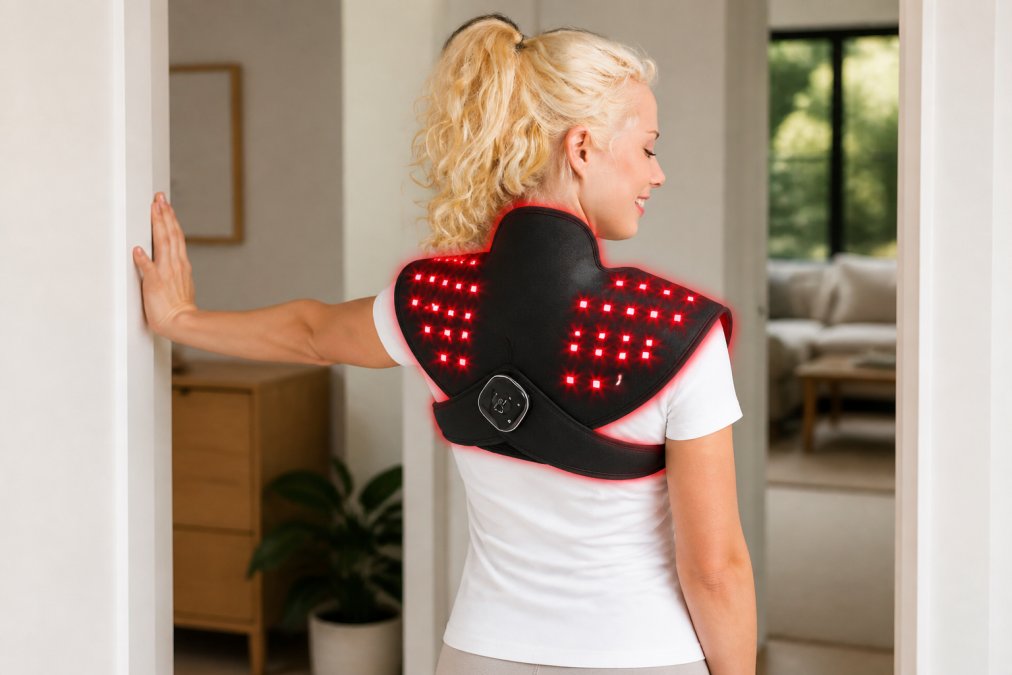
The Cordless Red Light Therapy for Neck Shoulder Pain Relief from TheCoolVibeShop delivers both 660nm red light and 850nm infrared light, penetrating deeper than red light alone. The cordless design lets you use it while working or relaxing, making consistency easier. Apply it directly to tight shoulder areas for 15-20 minutes daily.
Red light therapy also helps reduce inflammation, which is often a driver of chronic shoulder tightness. Tight muscles can create inflammation, which can trigger more tightness, a cycle that self-perpetuates. Red light can help break this cycle by supporting the body's natural processes in affected tissue.
Heat and Cold Therapy: When and How to Use Each
Heat and cold serve different purposes in managing shoulder tightness. Understanding when to use each accelerates recovery and prevents injury.
Use heat for chronic tension, stiffness, and muscle tightness that's been present for days or longer. Heat increases blood flow, relaxes muscles, and makes stretching more effective. Apply heat for 15-20 minutes before stretching or self-massage. A heating pad works, but devices with therapeutic heat, like the Neck Massager with Heat, combine heat with active muscle stimulation for results.
Use cold for acute inflammation, recent injuries, or sharp pain. Cold reduces inflammation and numbs pain temporarily. Apply cold for 10-15 minutes, several times daily. Never apply ice directly to skin, wrap it in a towel first.
For most chronic shoulder tension, heat is often more effective than cold. The tightness you're experiencing is usually muscular tension, not acute inflammation. Heat relaxes the tight muscles, while cold can sometimes increase tension by triggering protective muscle contraction.
The Topcupro 4-in-1 Red Light Therapy Wrap Device functions as both a heat and therapy device. Wear it for 20 minutes daily on your shoulder and upper back. The heat combined with red light therapy addresses both the muscular tension and any underlying inflammation, making it a comprehensive approach to shoulder relief.

Desk Ergonomics and Posture Correction for Daily Relief
Your desk setup is either preventing shoulder tightness or creating it. Most office workers unconsciously adopt postures that tighten their shoulders within hours of sitting down.

The core issue is monitor height. If your monitor sits below eye level, you'll round your shoulders forward and crane your neck downward, the exact posture that creates shoulder tension. Your monitor should be at eye level when you look straight ahead. If it's too low, use a monitor stand or stack of books to raise it.
Your chair height matters equally. Your elbows should bend at 90 degrees when your hands rest on your keyboard. If your chair is too high or too low, you'll create shoulder tension by reaching or hunching. Adjust your chair so your feet rest flat on the floor and your knees bend at 90 degrees.
Keyboard and mouse placement is where most people fail. Your keyboard should be directly in front of you, not off to one side. Your mouse should be at the same height as your keyboard, immediately beside it. Reaching for a mouse positioned too far away creates constant shoulder tension throughout the day.
Take a posture break every 60 minutes. Stand up, pull your shoulders back and down, and do a few doorway chest stretches. This interrupts the forward-rounded posture before it creates tension. Set a phone reminder if needed, most people forget without external prompts.
Poor desk ergonomics creates shoulder tightness faster than any other single factor. Even with stretching and massage, a bad desk setup will regenerate tightness within hours. Fix your ergonomics first, then add stretching and recovery tools.
Sleep Position and Recovery Optimization
How you sleep directly impacts shoulder tightness. Sleeping on your stomach forces your neck to rotate, creating tension in your shoulder and neck muscles throughout the night. Sleeping on your side can also create problems if your pillow is too high, forcing your shoulder into an awkward position.
Sleep on your back when possible. This position distributes your weight evenly and prevents shoulder compression. If you can't sleep on your back, side sleeping is acceptable, but use a pillow that supports your neck without elevating your shoulder. Your neck should be neutral, not bent upward.
Your pillow height is critical. A pillow that's too high forces your neck into flexion, creating tension in your trapezius and shoulder muscles. A pillow that's too low causes extension tension. The ideal pillow keeps your neck in a neutral position, the same alignment your neck would have standing upright.
Consider a body pillow if you sleep on your side. A body pillow supports your entire side, preventing your shoulder from rolling forward during sleep. This maintains proper shoulder alignment throughout the night, reducing morning tightness.
Sleep quality itself matters for muscle recovery. During deep sleep, your body repairs muscle damage and reduces inflammation. Poor sleep can perpetuate shoulder tightness because your muscles may not fully recover. Prioritize 7-9 hours of consistent sleep, and your shoulders will thank you.
Shoulder tightness doesn't require surgery or long-term medication. A combination of targeted stretching, self-massage, proper ergonomics, and recovery tools addresses the root causes of tension. The Cordless Red Light Therapy for Neck Shoulder Pain Relief from TheCoolVibeShop offers red and infrared light therapy, while the Neck Massager with Heat provides daily relief through TENS therapy and therapeutic heat. Start with the stretches and ergonomic adjustments today, add red light therapy for recovery, and you may notice significant improvement in shoulder mobility and comfort.
Frequently Asked Questions
How can I instantly relieve shoulder tension at work?
Start with shoulder rolls: rotate your shoulders backward 10 times, then forward 10 times. Follow with a cross-arm stretch, holding each side for 30 seconds. If you have a few minutes, using a neck massager with heat therapy can help target tight trapezius muscles. These quick techniques can provide relief without leaving your desk and can be repeated every 2-3 hours throughout your workday.
What are the benefits of red light therapy for muscle recovery from shoulder tension?
Red light therapy (660nm wavelength) stimulates cellular energy production and increases blood flow to tight muscles. For shoulder tension, it can help reduce inflammation, support muscle repair, and improve range of motion. A cordless red light therapy device designed for the neck and shoulders can be used 15-20 minutes daily to support ongoing tension relief and help prevent stiffness from returning.
How do I know if my shoulder tension needs medical attention?
Seek a doctor if you experience sharp, radiating pain down your arm, numbness or tingling, pain lasting more than 2 weeks despite home treatment, or limited range of motion that worsens. If shoulder tension follows an injury or prevents you from normal activities, professional evaluation is important. Most chronic desk-related tension responds well to self-care, stretching, ergonomic changes, and recovery tools, but a healthcare provider can rule out rotator cuff injury or nerve compression.
Can I use red light therapy and stretching together for faster results?
Yes, combining red light therapy with stretching can produce beneficial results. Apply red light therapy for 15-20 minutes to warm the tissue and increase blood flow, then perform shoulder stretches while muscles are warm and more receptive. This sequence can support myofascial release, enhance range of motion, and aid recovery. Repeat this combination 4-5 times per week for consistent tension relief and improved shoulder mobility over time.
This article was written using GrandRanker