Best Essential Oils for Muscle Knot Relief

Table of Contents
- Why Essential Oils Help With Muscle Knot Relief
- The Best Essential Oils for Muscle Pain, Ranked
- How to Dilute Essential Oils for Massage Safely
- Massage Techniques for Muscle Knots You Can Do Yourself
- Muscle Knot Relief at Home: Tools That Pair With Your Oil Blend
- Contraindications, Allergies, and Medication Considerations
- Conclusion
- Frequently Asked Questions
Last Updated: October 4, 2026
Why Essential Oils Help With Muscle Knot Relief
Muscle knots, those tender bands of tight muscle fiber that refuse to let go, respond to a combination of pressure, warmth, and time.
The key insight most guides miss: the oil isn't the treatment, the massage is.
Below, we break down which oils earn their place in a knot-relief routine, how to dilute them safely, and how to pair them with self-massage tools.
The Best Essential Oils for Muscle Pain, Ranked
Ranking oils for muscle knot relief comes down to one question: what sensation does the knot need? A fresh, overworked muscle responds to cooling. A chronically tight neck needs warming to draw blood flow.
One framing point most guides skip: essential oils are not proven to mechanically release a knot.
Here's how we rank them, based on how people actually use them and how forgiving each is on skin.
| Rank | Oil | Primary Sensation | Best For | Dilution Note |
|---|---|---|---|---|
| 1 | Peppermint | Cooling | Post-workout knots, tension headaches | Start at 1% |
| 2 | Lavender | Calming | Stress-driven neck and shoulder knots | Tolerates 2% well |
| 3 | Ginger | Warming | Deep, chronic tightness | Start at 1% or lower |
| 4 | Eucalyptus | Cooling, respiratory-opening | Knots paired with shallow breathing | Start at 1% |
| 5 | Rosemary | Warming, stimulating | Morning routines, pre-activity | Start at 1% |
| 6 | Chamomile (Roman or German) | Calming | Sensitive skin, evening use | Tolerates 2% well |
| 7 | Sandalwood | Grounding, warming | Slow, deliberate evening massage | Tolerates 2% well |
| 8 | Clary sage | Calming, slightly warming | Hormone-linked tension, monthly cycles | Start at 1% |
Peppermint Oil: The Cooling Standout
Peppermint is the oil most people reach for first.
Peppermint works best on fresh knots, the kind you get after a hard workout or a long day hunched over a laptop. For a knot that's been there for weeks, the cooling sensation fades before the muscle releases.
One caution: peppermint is strong. Undiluted, it can irritate skin and cause a lingering burning sensation.
Lavender and Chamomile for Stress-Driven Knots
Some knots aren't from exercise at all. They're from stress, and they live in the neck, shoulders, and upper back where tension accumulates during desk work. For those knots, the goal isn't to blast the muscle into submission.
Lavender is the best-known oil for this job: its calming aroma supports relaxation, and its gentle profile makes it one of the safest to use regularly.
Ginger, Rosemary, and Warming Oils for Deep Tension
Ginger belongs in the routine for the knot that's been camped out in your shoulder for a month. Warming oils increase blood flow, which helps tight muscle fibers relax and makes deep pressure more tolerable.
The tradeoff: warming oils need more caution. Ginger can cause strong, lasting heat on sensitive skin, so start at a lower dilution than lavender. Patch test on your inner forearm first.
Eucalyptus and Sandalwood: Two Underused Options
Eucalyptus is the oil for a knot in the upper back or shoulders paired with shallow, held breathing. Its cooling, camphor-like aroma opens the chest sensation and encourages slower breaths, which helps the surrounding muscle stop bracing.
Sandalwood adds a warm, grounding scent that pairs well with a slow evening massage. It's expensive, so most people use it as an accent oil rather than the base.
Choosing by Sensation, Not by Hype
A useful rule: match the oil to the sensation the knot wants, not the loudest marketing. Cooling oils (peppermint, eucalyptus) suit hot, fresh, inflamed areas. Warming oils (ginger, rosemary) suit cold, stiff, chronic areas.
One honest caveat: a stronger sensation doesn't mean a stronger therapeutic effect. A 1% peppermint blend and a 1% lavender blend both make massage possible; peppermint just feels like more is happening.
How to Dilute Essential Oils for Massage Safely
Diluting essential oils for massage means mixing them with a carrier oil, jojoba, sweet almond, or fractionated coconut oil, before they touch your skin.
The standard starting point for adults is a 2% dilution, roughly 12 drops of essential oil per ounce of carrier oil, or about 6 drops per tablespoon.
Wood Therapy Massage Stick – Handheld Body Massage Tool →
An easy blend: 6 drops peppermint, 4 drops lavender, and 2 drops ginger in one ounce of carrier oil, a cooling, calming, mildly warming mix that suits most knot-relief sessions.
Massage Techniques for Muscle Knots You Can Do Yourself
Massage techniques for muscle knots follow one principle: sustained pressure beats quick rubbing. A knot releases when you hold steady pressure long enough for the muscle fibers to stop guarding. Fast, aggressive rubbing usually makes the surrounding tissue tighten in defense.
Here's a simple sequence you can do at home:
- Warm the area first with a hot shower or a warm compress for five minutes.
- Apply your diluted oil blend to your hands and the target area.
- Locate the knot by pressing gently until you find the spot that feels tender or refers a dull ache.
- Hold steady pressure on that spot for 30 to 60 seconds, breathing slowly.
- Use slow, broad strokes along the muscle fiber to finish, moving away from the knot.
- Repeat on the other side, even if it doesn't hurt. Compensation patterns are common.
For the neck and shoulders, gentle circular pressure with your fingertips works better than deep thumb digging. For the back and legs, a handheld tool lets you apply more pressure with less strain on your hands.
Muscle Knot Relief at Home: Tools That Pair With Your Oil Blend
Muscle knot relief at home works best when your hands aren't the only tool doing the work.
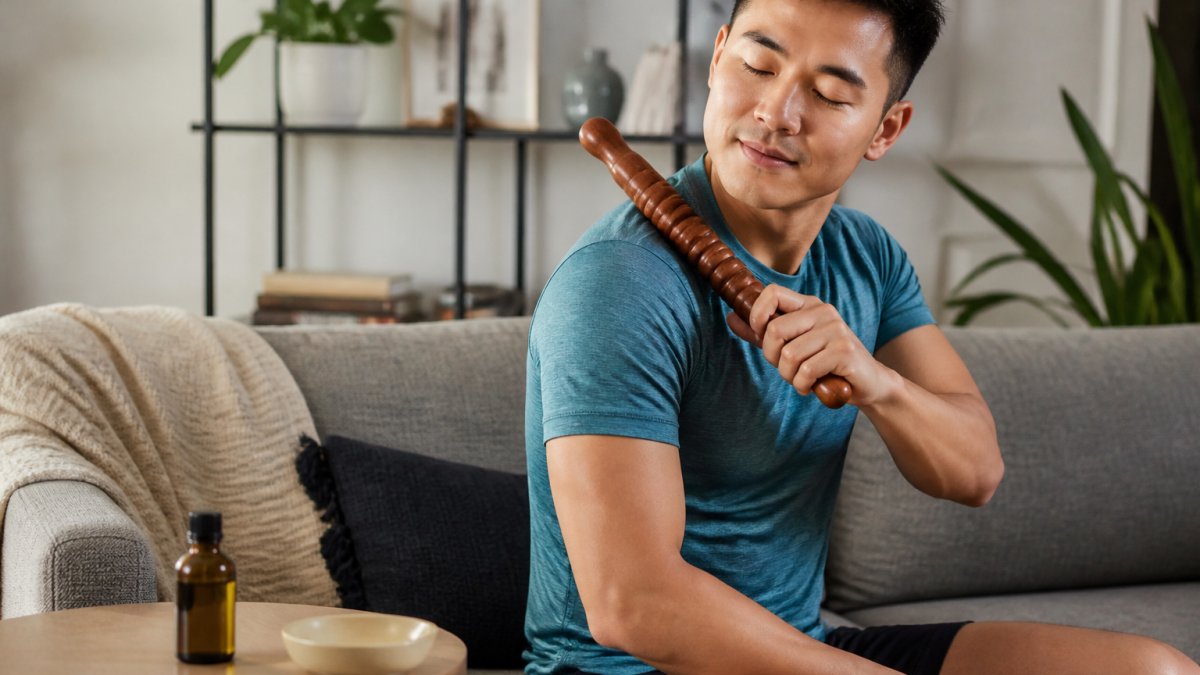
The Wood Therapy Massage Stick is our pick for full control over pressure and movement.

For deeper, sustained pressure on trigger points, the Red Light Cupping Kit combines cupping massage with red light therapy.

If your knots are concentrated in the neck and shoulders, the Neck Massager with Heat adds heat therapy and customizable TENS-style stimulation to your oil routine.

Contraindications, Allergies, and Medication Considerations
Essential oils are concentrated plant compounds and can cause reactions. Before using any oil for the first time, patch test: apply a drop of the diluted blend to your inner forearm, cover it with a bandage, and wait 24 hours. If redness, itching, burning, or a rash develops, don't use that oil. The 24-hour wait matters because some reactions, particularly to citrus and warming oils, are delayed.
Dilution Ceilings to Respect
Dilution is the single most important safety lever. For adults, 2% is the standard ceiling for most oils, about 12 drops per ounce of carrier oil. Strong oils like peppermint, ginger, eucalyptus, and rosemary should start at 1% (about 6 drops per ounce) and only increase if your skin tolerates it. There's no benefit to going above 2% for knot relief, and irritation risk rises faster than any perceived benefit.
Who Should Be Extra Cautious
- Pregnant or nursing people should talk to a healthcare provider before using essential oils topically, especially over a large area or on the abdomen. Peppermint, rosemary, and clary sage are commonly flagged for extra caution during pregnancy.
- People with asthma or other respiratory conditions should be careful with strong aromatic oils, particularly peppermint and eucalyptus, which can trigger coughing or bronchial tightening. If you have reactive airways, test in a well-ventilated room and stop if breathing feels tighter.
- People with sensitive skin or eczema should start with lavender or chamomile, patch test every new oil, and keep dilutions at or below 1% until they know how their skin responds.
- Children should not use menthol-heavy oils like peppermint on the face or near the nose. For children over age 6, a 0.5% to 1% dilution is a common starting point, and a pediatrician should be consulted first.
- People taking prescription medication, particularly blood thinners or blood pressure medication, should check with their doctor before using warming oils that affect circulation. Some oils can interact with medications, and topical use over a large area increases absorption.
Oil-Specific Cautions
- Peppermint and other menthol-heavy oils should not be used on the face or near the nose of infants and young children. Keep them away from the eyes entirely, and wash hands after applying.
- Citrus-based oils can make skin more sensitive to sunlight. If you use them, avoid sun exposure on the treated area for several hours.
- Ginger and cinnamon are among the stronger warming oils and cause irritation more often than gentler options. Use lower dilutions and test first.
- Clary sage is sometimes avoided by people who are pregnant or trying to conceive, and it can cause drowsiness in some users.
When a Knot Is Not a Knot
If a knot is accompanied by swelling, bruising, numbness, or pain that radiates down an arm or leg, see a healthcare provider. That pattern can indicate a nerve issue, a strain, or something that oil and massage will not fix. Similarly, a knot that gets worse with massage, or that comes with fever, unexplained weight loss, or night pain, warrants medical evaluation rather than another massage session.
Conclusion
Muscle knots respond to consistency more than intensity. The best essential oils for muscle knot relief, peppermint for cooling, ginger for warming, lavender and sandalwood for calming, only work as part of a routine you'll actually repeat.
That's where TheCoolVibeShop comes in. Our non-invasive, drug-free wellness tools are built for exactly this kind of everyday use: the Wood Therapy Massage Stick for control over pressure and movement, the Red Light Cupping Kit for circulation and relaxation, and the Neck Massager with Heat for warmth.
Get started with TheCoolVibeShop and build a knot-relief routine that fits into your day, not one that takes it over.
Frequently Asked Questions
What are the best essential oils for muscle pain?
Peppermint oil is the most studied for muscle knots because menthol creates a cooling sensation that can reduce perceived pain. Ginger and other warming oils suit deep, stubborn tension. Lavender and sandalwood work best when stress is feeding the knot. Most people get the best results from a blend: one cooling oil, one warming oil, and one calming oil, diluted in a carrier oil before topical application.
How do you dilute essential oils for massage?
Use a 2 to 3 percent dilution for localized muscle knots. That means roughly 12 to 18 drops of essential oil per 1 ounce (30 ml) of carrier oil such as jojoba, sweet almond, or fractionated coconut oil. For larger areas or sensitive skin, drop to 1 percent, about 6 drops per ounce. Always blend in a glass bottle, shake well, and patch test on your inner forearm for 24 hours before wider use.
Can peppermint oil help with muscle knots?
Peppermint oil is one of the most common choices for muscle knots because its menthol content creates a cooling sensation that can temporarily dull pain signals and ease tight muscles. It works well for neck and shoulder tension, but it should always be diluted. Never apply it near your eyes, and avoid it if you have sensitive skin or are using menthol-containing topical pain products.
How often can you use essential oils on sore muscles?
Two to three times per day is a reasonable ceiling for diluted topical use on a specific area. Give your skin a break between sessions and watch for redness, itching, or irritation. If you are using a massage tool alongside your oil blend, keep pressure moderate and stop if the area feels bruised. Persistent or worsening pain warrants a visit to a healthcare provider.
How can you relieve muscle knots fast?
Combine three things: a diluted essential oil blend, direct pressure on the knot, and heat. Apply your oil, then use a thumb, knuckle, or handheld massage tool to press into the trigger point for 30 to 60 seconds while you breathe slowly. Follow with a warm compress. This approach addresses circulation, muscle tension, and relaxation at once, which is why it tends to work faster than any single method alone.