Best Achedaway Alternatives for Deep Tissue Massage

Table of Contents
- Why Look Beyond Achedaway for Deep Tissue Massage
- Top Picks: Best Recovery Tools for Athletes and Desk Workers
- How to Use a Muscle Scraper for Deep Tissue Release
- Massage Gun vs Muscle Scraper for Recovery: Which Wins?
-
Key Features to Compare in Deep Tissue Massage Tools
- Stall force: test it, don't trust the box
- Amplitude: the spec that decides depth per stroke
- Percussion frequency: strokes per minute, and why higher isn't better
- Heat: temperature range matters more than 'has heat'
- Battery: watt-hours, not milliamp-hours
- Ergonomics and grip: the spec nobody lists
- Quick reference: what to measure, and a realistic target
- Long-Term Reliability and Integration with Physical Therapy
- Frequently Asked Questions
Last Updated: September 12, 2026
Why Look Beyond Achedaway for Deep Tissue Massage
The best Achedaway alternatives for deep tissue massage match the job, not the marketing. Percussion guns get the attention, but cupping kits, TENS units, wood therapy sticks, and red light wraps often reach tension a single vibrating head cannot. At TheCoolVibeShop, we hear from desk workers and gym-goers who own a gun and still feel locked up.

Deep tissue massage applies sustained pressure to the inner layers of muscle and fascia, targeting trigger points and adhesions that restrict movement.
Most buyers assume more power equals more relief. In practice, the tool has to match the tissue: a stiff upper back responds to sustained mechanical pressure, a sore knee to heat and light. One device rarely covers both. Below, we break down six alternatives, plus how to choose between them.
Top Picks: Best Recovery Tools for Athletes and Desk Workers
The strongest recovery options combine targeted pressure with heat, light, or suction. Pick by where you feel the tension, not by price.
| Tool | Price | Best For | Key Feature |
|---|---|---|---|
| Cupping Kit with Red Light | $139.99 | Back, shoulders, cellulite | 12 suction levels |
| Neck Massager with Heat | $97.50 | Desk workers, neck pain | 50 intensity levels |
| Wood Therapy Stick | $98.99 | Lymphatic drainage, legs | 21-inch reach |
| Topcupro 4-in-1 Wrap | $154.99 | Joints, knees, elbows | 96 LED chips |
| Cordless Neck/Shoulder Light | $299.99 | Upper back, circulation | 660nm + 850nm |
| YZYOE Infrared Wand | $72.99 | Face and small areas | 3 wavelengths |
Cupping Kit for Massage Therapy with Red Light
The most versatile pick, combining cupping, scraping, massage, heating, and red light in one rechargeable device, with 12 suction levels and auto-shutoff.

The neck, arms, shoulders, back, and legs all respond well to suction-based soft tissue mobilization, and the pressure relief button lets you dial back intensity mid-session.
The drawback: cupping leaves temporary marks, so plan around short sleeves.
Neck Massager with Heat and TENS Therapy
Desk workers with locked shoulders get the most from this one. The U-shaped 3D pad conforms to the cervical spine, and low-frequency pulses simulate kneading, tapping, and acupressure.
You get 9 modes, 50 intensity levels, and constant heat between 100.4°F and 107.6°F, which promotes circulation and relaxes muscle before the pulses do their work (peer-reviewed research).
Where it falls short: it is built for the neck, not the lower back.
Wood Therapy Handheld Massage Stick
A 21-inch wooden roller is the low-tech option that still delivers, working the arms, legs, thighs, waist, and abdomen. Beveled edges make mechanical scraping safe on skin.
Athletes use it for lymphatic drainage and post-workout soreness, and it is a common cellulite-reduction pick because the rolling motion supports circulation.
The catch: it requires manual effort, and results build over consistent sessions.
Topcupro 4-in-1 Red Light Therapy Wrap
Joint pain is where this wrap earns its place. It fits knees, elbows, shoulders, and ankles, using 96 two-in-one LED chips across an elastic band that wraps the full joint.
The 20-minute auto-shutoff keeps sessions simple, and USB-C power runs it from a battery bank. For age-related stiffness, it is a practical daily tool.
One limitation: it is not a pressure device, so it will not break up a deep knot the way suction or scraping can.
Cordless Red Light Therapy for Neck and Shoulder
The premium option for upper-body tension, pairing 660nm red light for surface circulation with 850nm near-infrared light that penetrates deeper into tissue and joints.
Five modes, a 10 or 20-minute timer, and a 3000mAh battery make it genuinely portable, with an intuitive smart touch screen.
The trade-off is price. At $299.99 it costs more than the rest of the list, which matters if you are unsure you will stick with a routine.
YZYOE Infrared Light Therapy Wand
Small, focused, and the cheapest entry point at $72.99. Three wavelengths target the face, jaw, or small muscle groups larger pads cannot reach.
It suits anyone curious about light therapy before committing to a bigger device. It will not replace deep pressure work on a stubborn back knot.
How to Use a Muscle Scraper for Deep Tissue Release
A muscle scraper drags a beveled edge across the skin at a shallow angle to break down adhesions and improve tissue glide. Technique matters more than the tool.
- Warm the area first with heat or light for 5-10 minutes
- Apply oil or lotion so the edge glides without pulling skin
- Hold the scraper at roughly 45 degrees, never perpendicular
- Use short strokes in one direction, 5-10 passes per area
- Work along the muscle, not across the joint
- Stop if you see more than light redness
- Follow with gentle stretching and hydration
A common mistake is pressing too hard on the first session. Start light. The tissue responds to consistency, not force.
Massage Gun vs Muscle Scraper for Recovery: Which Wins?
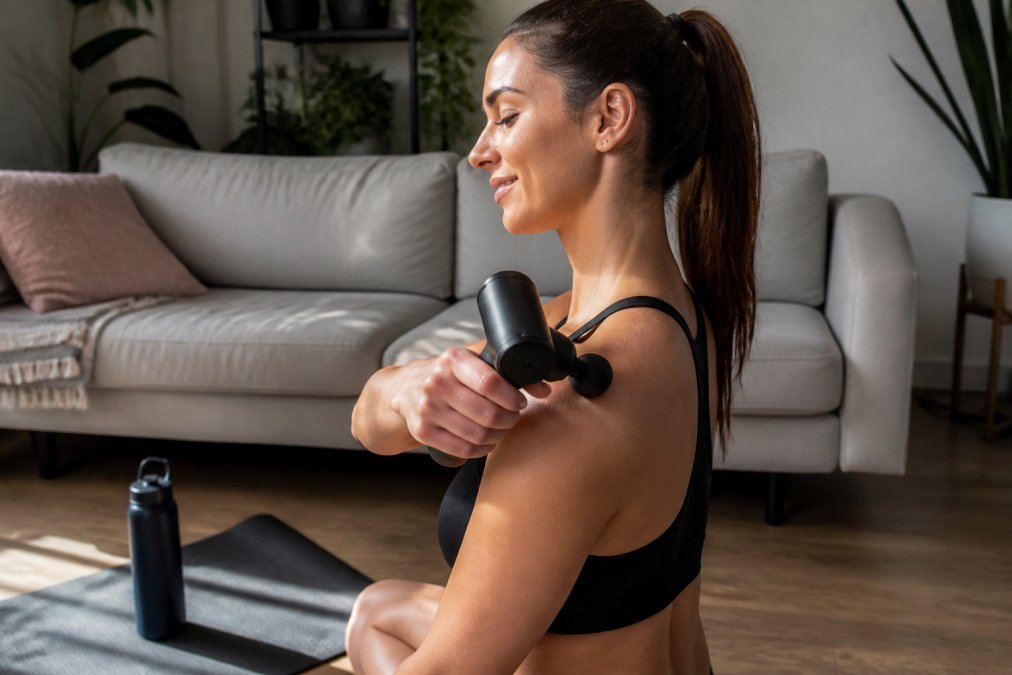
A massage gun wins for quick, hands-free relief on large muscle groups. A muscle scraper wins for precision work on fascia and stubborn trigger points. They solve different problems.
Percussion therapy delivers rapid pulses that reduce soreness and increase blood flow, while mechanical scraping applies sustained shear force that targets adhesions directly.
For DOMS after a hard workout, the gun is faster. For chronic tightness that never fully releases, the scraper reaches deeper.
Many people end up using both. Gun first to warm the tissue, scraper second to break up what remains.
Key Features to Compare in Deep Tissue Massage Tools
Most reviews list the same four specs and stop, which is why they all read the same. The gap is measurement: what a spec means at the tissue, and how to test it before the return window closes. Here is a framework you can run at home in about 20 minutes per tool.
Stall force: test it, don't trust the box
Stall force is the pressure a percussion motor withstands before it stops oscillating, and marketing numbers are often peak, not sustained. Home test: press the running device into a bathroom scale at a 45-degree angle and note the reading when the head stops moving; repeat three times and average. If a listing claims far more than your scale shows, it is quoting a peak spike, not usable force. Why it matters: a tool that stalls at 20 lb cannot reach the deep paraspinal or gluteal tissue no matter how long you hold it. A tool that holds 50 lb can, but only if you can tolerate the pressure.
Amplitude: the spec that decides depth per stroke
Amplitude is how far the head travels per cycle, usually in millimeters, ranging from roughly 6 mm on compact travel guns to 16 mm on full-size units (peer-reviewed research). Deeper amplitude moves more tissue per stroke, meaning fewer passes and less skin irritation. For deep tissue work on large muscle groups, 10 mm or more is the practical floor; for neck and jaw work, a shorter amplitude is easier to control.
Percussion frequency: strokes per minute, and why higher isn't better
Frequency is listed in percussions per minute (PPM), typically 1,200-3,200, and higher is not automatically better. Lower frequencies (under ~1,800 PPM) feel more like sustained pressure and suit trigger-point work; higher frequencies suit flushing and warm-up. A single-speed device is a real limitation for anyone doing both.
Heat: temperature range matters more than 'has heat'
Heat relaxes muscle before pressure is applied, making every other feature work better, but 'has heat' is not a spec, look for a stated range. The neck massager here runs 100.4°F to 107.6°F, in the therapeutic warm range: enough to increase local circulation without burning thin skin. Anything above roughly 113°F held against the neck for 20 minutes is a burn risk, especially with reduced sensation (PubMed).
Battery: watt-hours, not milliamp-hours
A 3000mAh battery tells you almost nothing without voltage. Watt-hours (Wh) is the honest number: amp-hours times voltage. A 3000mAh cell at 3.7V is about 11 Wh; the same cell at 7.4V is about 22 Wh. For daily use, most users need roughly 60-90 minutes of runtime per charge, so ask the seller for runtime at the highest speed, not the lowest.
Ergonomics and grip: the spec nobody lists
A device with a poor grip will not get used, no matter how good the specs look. Check handle diameter (most hands do best between 1.5 and 2 inches) and reach: can you place the head on your own upper back without craning? If not, it is a two-person device whether the listing says so or not.
Quick reference: what to measure, and a realistic target
| Spec | How to test at home | Practical target for deep tissue |
|---|---|---|
| Stall force | Press into a bathroom scale at 45°, note the stall reading | 30 lb sustained or higher |
| Amplitude | Check the listing; verify by feel on a firm surface | 10 mm or more for large muscles |
| Frequency | Count speeds; note the lowest setting | At least one setting under ~1,800 PPM |
| Heat | Check the stated range | 100°F-108°F for neck and shoulder use |
| Battery | Time a full charge at top speed | 60-90 minutes of runtime |
| Grip | Hold it for a full 10-minute session | No hand fatigue, reachable upper back |
None of these tests require lab equipment. They require 20 minutes and a willingness to send back a tool that does not measure up.

Long-Term Reliability and Integration with Physical Therapy
This is where most reviews stop, and where the real money is spent. A tool that dies in six months is no bargain, and one used wrong for a specific injury can set recovery back. Two things decide whether a purchase pays off: how the device holds up, and whether it fits an actual rehab protocol.
What actually fails first
Across percussion guns, cupping devices, and light-therapy units, the same parts tend to go in the same order:
- Battery cells. Lithium-ion packs lose capacity with charge cycles. A device that ran 90 minutes new often runs 50-60 after a year of daily use. This is the single most common failure, and on most sealed units it is not user-replaceable.
- Motor brushes and bearings. On brushed motors, brush wear shows up as a grinding sound or reduced stall force before total failure. Brushless motors last longer but cost more up front.
- Charging ports. USB-C ports collect lint and loosen with repeated plugging. A port that stops charging is often the end of an otherwise working device.
- Silicone and suction seals. On cupping kits, the seal is the wear item. A seal that no longer holds vacuum makes the whole device useless, even though nothing electrical has failed.
- LED arrays. On red-light wraps, individual diodes can fail. A wrap that loses a cluster of chips still works but delivers uneven dose across the treatment area.
Repairability: the question to ask before you buy
Ask any seller three questions: Is the battery user-replaceable? Are replacement seals or heads sold separately? Does the warranty cover the whole unit or just the motor?
A one-year warranty on the whole unit is a reasonable floor; one covering only the motor while excluding the battery is close to worthless, since the battery usually fails first. Stainless steel contact surfaces, sealed motors, and clearly stated terms mark a tool built to last. TheCoolVibeShop backs its range with a reassuring 60-day money-back guarantee, enough time to run the tests above.
Integration with physical therapy: protocols, not vague advice
Bringing your tool to appointments and asking your therapist which settings suit your injury is good advice, but it is not a protocol. Here are starting points for three common complaints, general patterns, not prescriptions, and your therapist's guidance overrides them.
Plantar fasciitis. Target the arch and calf, not the heel. A percussion gun on low-to-mid along the calf (gastrocnemius and soleus) for 1-2 minutes per area, then slow rolling of the arch with a wood stick or firm ball, is a common pre-stretch routine: heat before, stretching after. Avoid aggressive percussion on the already-inflamed heel pad.
IT band syndrome. The IT band is thick and low-vascularity, so it does not respond well to direct pounding. Work the surrounding tissue instead, gluteus medius, TFL, and vastus lateralis. A scraper at a shallow angle along the outer thigh, 5-10 light passes, then glute work with a percussion gun, beats hammering the band.
Upper trap and desk-neck tension. Heat first, the neck massager here runs 100.4°F to 107.6°F, enough to relax tissue before pressure. Then light percussion or cupping on the upper traps and rhomboids, staying off the cervical spine. The goal is to restore glide, not force range of motion in one session.
A note on dosing
More is not better. Most soft-tissue tools are dosed in minutes per area per day, not hours: commonly 1-2 minutes per muscle group, once or twice daily, with a rest day when tissue feels irritated. Overuse shows up as increased soreness the next day, the opposite of the goal.
Frequently Asked Questions
Is Achedaway worth the money compared to cheaper alternatives?
You can find effective deep tissue massage tools for less. The Cupping Kit for Massage Therapy with Red Light at $139.99 offers 5-in-1 functionality including cupping, scraping, and red light therapy. For targeted neck relief, the Neck Massager with Heat at $97.50 provides TENS pulses and constant heat. Focus on features that match your specific pain points rather than brand name.
What is the best tool for myofascial release at home?
The best tool depends on your needs. For broad areas like back and legs, a massage gun or the Wood Therapy Handheld Massage Stick ($98.99) works well. For precise trigger points, a muscle scraper or the Cupping Kit with 12 suction levels ($139.99) provides targeted deep tissue relief. Red light therapy devices like the YZYOE Wand ($72.99) add cellular recovery benefits. Many users combine two tools for best results.
Can at-home deep tissue tools effectively replace physical therapy?
At-home tools can complement physical therapy but rarely replace it entirely. Devices like the Topcupro 4-in-1 Red Light Therapy Wrap ($154.99) and the Cordless Red Light Therapy for Neck Shoulder ($299.99) help manage muscle soreness and improve circulation between sessions. However, for acute injuries or chronic conditions, a licensed physical therapist should guide your treatment plan. Use these tools as part of a broader recovery routine.
How do heated muscle scrapers compare to traditional massage guns?
Heated muscle scrapers, like the Wood Therapy Handheld Massage Stick ($98.99), apply direct pressure and friction to break down adhesions, while massage guns use rapid percussion to stimulate blood flow. Scrapers offer more control for myofascial release and can reach beveled edges around joints. Massage guns cover larger areas faster. For deep tissue work, many athletes prefer scrapers for precision and guns for warm-up or recovery.
What features should I look for in a muscle recovery scraper?
Look for stainless steel or dense wood construction, beveled edges for safety, and an ergonomic grip. The Wood Therapy Handheld Massage Stick ($98.99) is 21 inches long, letting you reach your back without strain. Adjustable intensity settings, like the 12 suction levels on the Cupping Kit ($139.99), help customize pressure. Also check for portability and battery life if you want to use it at the gym or office.
Tension that never fully releases is frustrating, and guessing at tools wastes both money and time. TheCoolVibeShop offers non-invasive, drug-free wellness essentials designed for safe daily use, from red light therapy devices to gentle massage tools that support muscle soreness and joint relief. Every purchase is backed by a 60-day money-back guarantee and trusted by more than 1,500 customers. Get started with TheCoolVibeShop and build a recovery routine that actually fits your body.